Martin Parr is one of those photographers who have profoundly shaped the history of contemporary photography.
His influence is immense. His vision is instantly recognizable. His humor as well.
And yet, as I left the exhibition at the Jeu de Paume, I was left with mixed feelings.
Not because I have stopped appreciating his work. Quite the opposite.
But because this retrospective reminded me how much certain periods of his work resonate with me more than others.
I first discovered Martin Parr through his photographs from the 1970s and 1980s. Those taken in small English towns, Yorkshire villages, or the Irish countryside. Work often in black and white, deeply rooted in reality, where humor never erased humanity.

I am thinking in particular of The Non-Conformists and his Irish series.
In these images, there is a kind of gentleness.
A sincere attention to people.
A rare ability to portray a society without ever reducing it to caricature.
For me, the first rooms of the exhibition are the most moving.
They reveal a patient photographer, close to his subjects, capable of transforming an ordinary scene into a universal image.
These photographs tell the story of England.
But they also speak of the passage of time, of communities that are disappearing, of traditions slowly fading away.
They possess that rare quality of great documentary photography: they grow stronger with time.
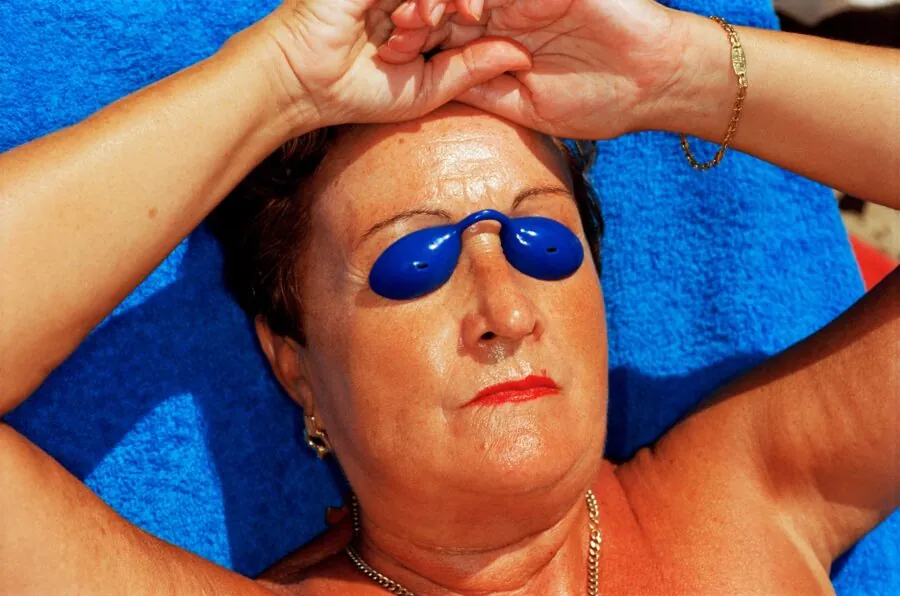
Then comes color.
That color which would make Martin Parr one of the most famous photographers of his generation.
A revolution in itself.

Because it is important to remember that at the time, using such saturated colors in documentary photography was almost provocative.
Parr disrupted the codes.
He introduced irony, excess, mass consumption, popular leisure, tourism, and the absurdities of everyday life into the realm of authorial photography.
And he did so with extraordinary talent.
Some of these images have become iconic.
They now belong to our collective memory.
They have influenced entire generations of photographers.
Yet, despite all the admiration I have for this period, I must admit that it resonates with me less on a personal level.
Perhaps because humor sometimes takes precedence over emotion.
Perhaps because the social critique becomes more direct.
Or perhaps because I remain attached to that Martin Parr who was still observing his own world with an almost affectionate closeness.

But this preference is above all a matter of sensitivity.
Because the exhibition brilliantly reminds us of one essential fact: Martin Parr is one of the rare photographers who has managed to build a coherent body of work over more than fifty years while constantly renewing his vision.
Few artists can claim as much.
His work now stands as a unique archive of the transformations of the United Kingdom, but also of Europe and the contemporary world.
Through his images, it is our habits, our excesses, our leisure activities, our dreams of consumption, and sometimes our contradictions that pass before us.
And perhaps that is where his greatest strength lies.
Martin Parr does not only photograph others.
He photographs all of us.

Even when we would rather not recognize ourselves.
I left the Jeu de Paume wanting to revisit his books.
And above all, with the desire to return to his early English and Irish series—the ones that first made me love his work long ago.
That is probably the finest compliment one can pay to an exhibition.
To make us want to go back to the photographs.
Grégory Herpe


MARTIN PARR
Global Warning
Du 30 janvier au 24 mai 2026
Jeu de Paume – Paris
Tel : +33 (0)1 47 03 12 50 Mail: accueil@jeudepaume.org

Leave a Reply