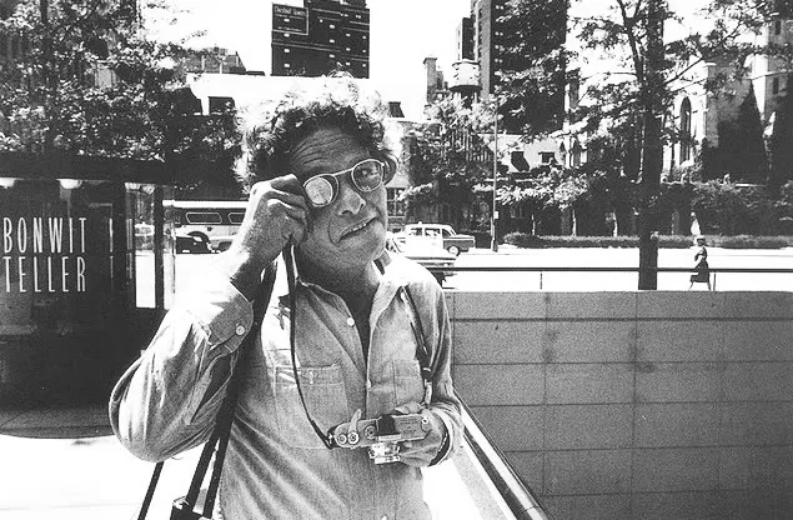
There are photographers we admire for their technical mastery. Others for their commitment or their vision.
And then there are those rare photographers who fundamentally change the way we see.
Gary Winogrand belongs to that category.
I can no longer remember exactly when I first encountered his work. What I do remember is the feeling it gave me. A sense of absolute freedom. The impression that someone had finally managed to photograph life as it truly is: fast, messy, contradictory, often funny, sometimes absurd.
For a long time, I believed photography was about bringing order to the world. Finding the perfect frame, organizing the elements, building a balanced composition. Winogrand taught me something different. He taught me that the world does not need to be perfectly arranged in order to be fascinating.
Born in the Bronx in 1928 to Jewish immigrant parents from Eastern Europe, Gary Winogrand grew up in the noise and energy of New York City. A city that never stops moving. A city that would become his favorite field of observation.
After studying painting and later photography, he began working for illustrated magazines. But it did not take long for him to realize that assignments interested him less than what was happening outside. Out in the streets. Among ordinary people.
He understood that his subject was not a particular event.
His subject was life itself.
A life overflowing in every direction.
A life impossible to control.
A life that never pauses for the photographer.
From the 1950s onward, he wandered through New York for hours on end, Leica in hand. Most often equipped with a 28mm lens, a focal length that forced him to get close to people, to enter their space, to become part of the scene rather than merely observe it from a distance.
That proximity gives his photographs their unique intensity.
You never feel as though you are watching from across the street.
You are there.
In the middle of the crowd.
At the heart of the movement.
The Photographer of Organized Chaos
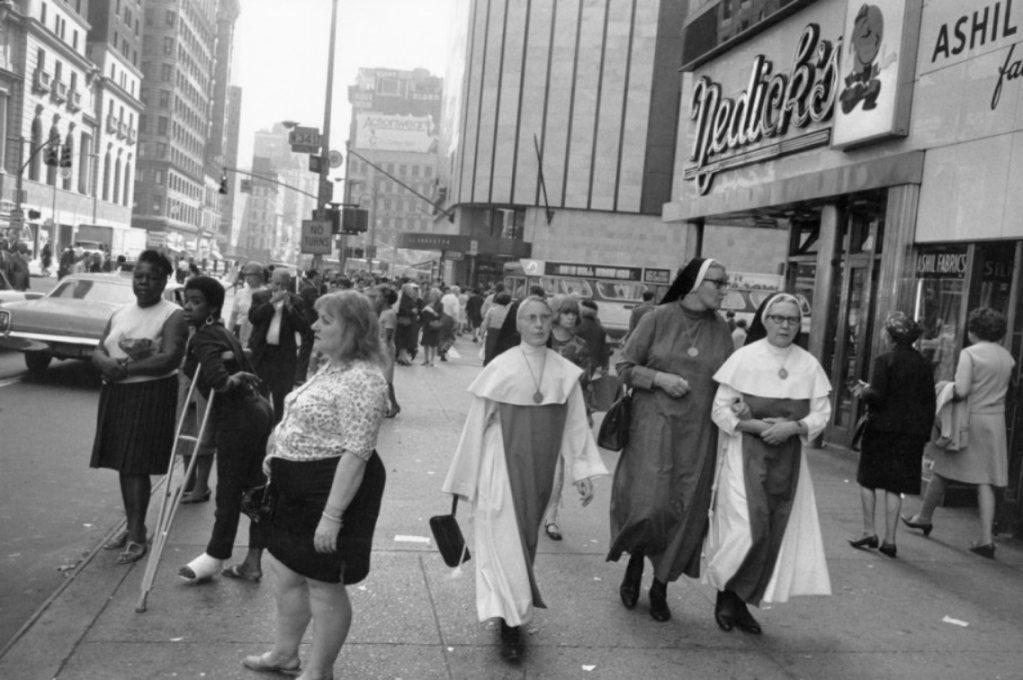
At first glance, Winogrand’s photographs can seem almost poorly constructed.
Horizons tilt.
People are cut off.
Frames appear unbalanced.
Some pictures feel as though they were taken a fraction of a second too early or too late.
Yet that impression quickly disappears once you spend time with them.
Because beneath the apparent disorder lies an extraordinary visual intelligence.
Winogrand was not photographing chaos.
He was photographing complexity.
The difference is crucial.
Unlike Henri Cartier-Bresson, he was not searching for geometric perfection. He was searching for collisions.
Unexpected encounters between different realities.
He wanted several stories to coexist within the same frame.
He photographed the disorder of the world without simplifying it.
That is precisely why his work continues to feel so alive.
His photographs still surprise us.
Photographs That Demand Time
Most great photographs can be understood within a few seconds.
Winogrand’s work operates differently.
You look once.
Then again.
Then a third time.
And each time something new emerges.
A glance.
A gesture.
A tension.
An invisible relationship between two strangers.
A subtle irony.
A secondary scene that suddenly becomes the true subject of the photograph.
This richness explains why so many photographers return to his work again and again.
His images resist easy interpretation.
They refuse to reveal everything at first glance.
A Few Photographs That Explain Winogrand
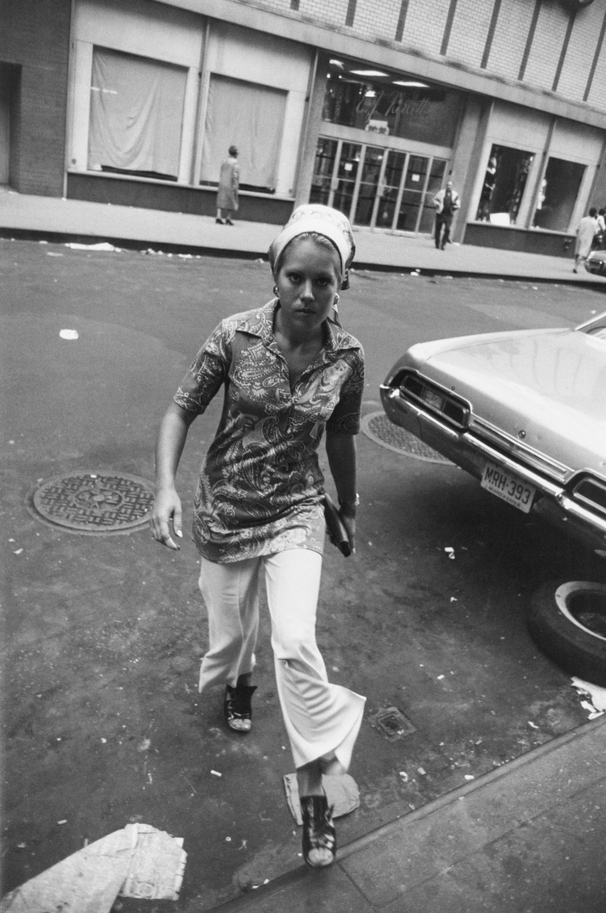
Certain photographs immediately reveal what made his vision so unique.
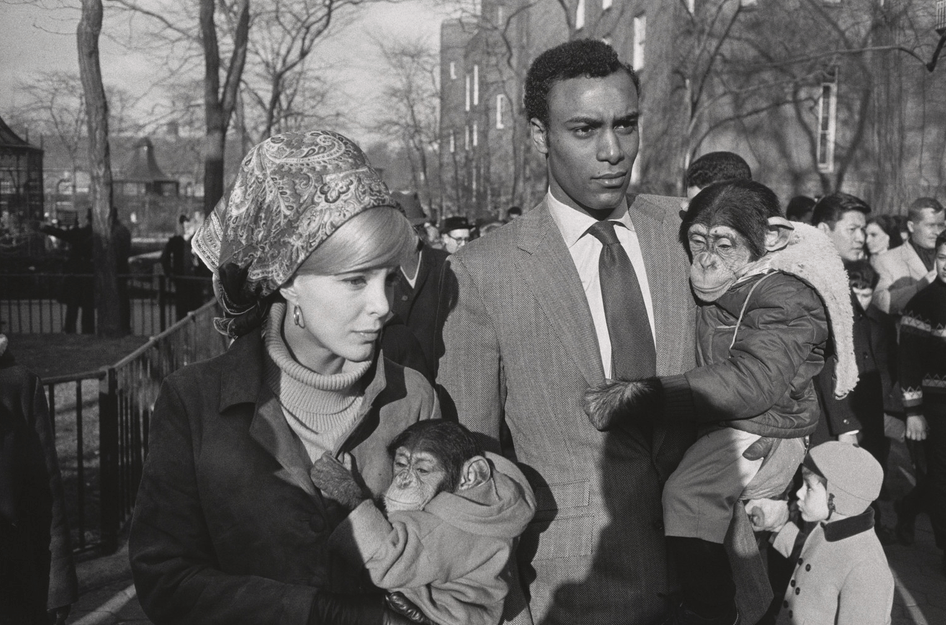
Central Park Zoo, New York, 1967
This is probably one of his most famous photographs.
A well-dressed young couple walks through the Central Park Zoo.
The woman is holding the hands of two chimpanzees dressed like children.
The scene is entirely real.
Yet it feels completely surreal.
Everything that defines Winogrand is present in this image.
Humor.
Absurdity.
Ambiguity.
A quiet sense of unease.
Nobody in the photograph seems surprised by the situation.
Neither does the photographer.
He simply observes.
And it is precisely this lack of commentary that makes the image so powerful.
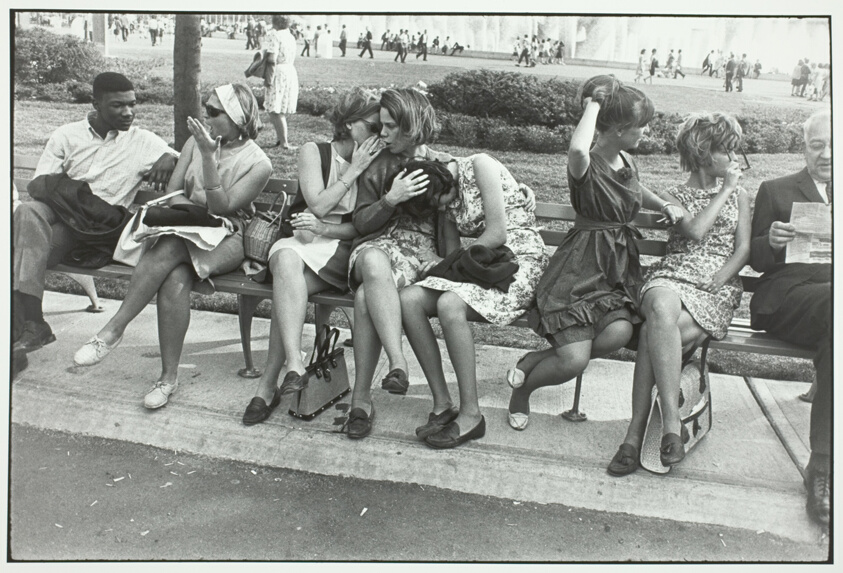
World’s Fair, New York, 1964
This photograph captures the optimism of 1960s America.
A nation convinced that technology and progress would solve every problem.
But in Winogrand’s work, beneath the official narrative, there are always more complex stories unfolding.
Attitudes.
Distances between people.
Lost gazes.
Unconscious gestures.
Everything that escapes the public message becomes his real subject.
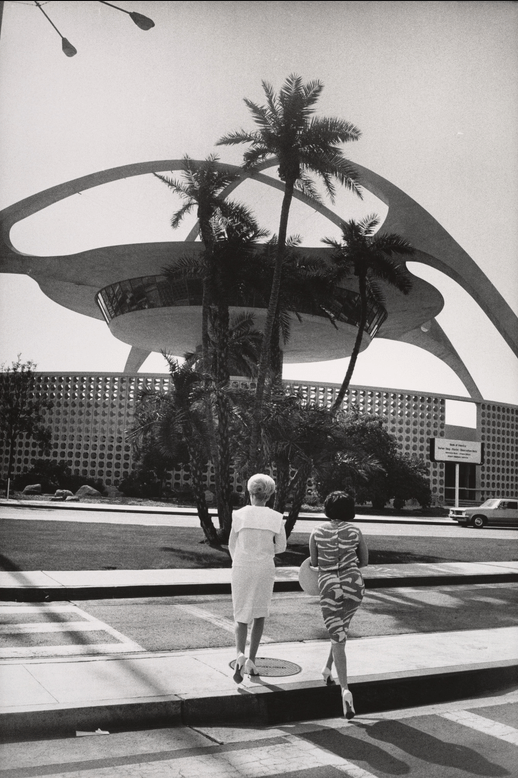
Los Angeles Airport, 1964
Airports fascinated Winogrand.
They are places filled with departures, reunions, waiting, boredom and loneliness.
A concentration of human emotions in a single location.
In his airport photographs, everyone seems to be both the main character of their own story and a minor figure in someone else’s.
It is a deeply modern vision of contemporary life.
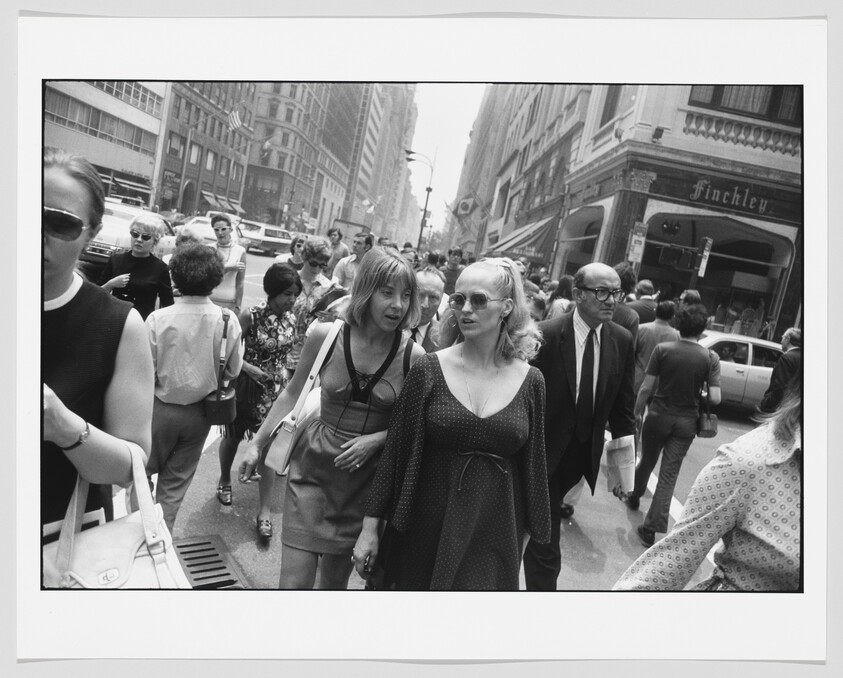
Fifth Avenue
The photographs he made along New York’s famous avenue rank among the finest examples of street photography ever produced.
Winogrand transforms an ordinary walk into a human theatre.
Social classes intersect.
Generations collide.
Elegant women pass by drifters.
Tourists cross paths with businessmen.
All within a single frame.
All within a single second.
A Lasting Influence
In 1967, John Szarkowski, then Director of Photography at the Museum of Modern Art, organized the landmark exhibition New Documents.
Alongside Diane Arbus and Lee Friedlander, Winogrand occupied a central place in that exhibition.
It marked a turning point in photographic history.
Documentary photography was no longer merely about recording or exposing social realities.
It became a way of exploring them.
A way of embracing the world’s complexity.
That approach would influence generations of photographers.
Joel Meyerowitz, Tod Papageorge, Alex Webb, David Alan Harvey, Matt Stuart and countless others still carry part of his legacy today.
A Lesson in Photography
One of Winogrand’s most quoted remarks is:
“I photograph to see what the world looks like photographed.”
The older I get, the deeper that sentence feels.
It reminds us that photography is not a copy of reality.
It is an interpretation.
A transformation.
A passage between two worlds.
The world we see.
And the world revealed by the photograph.
Winogrand spent his life exploring that fragile territory.
He photographed obsessively.
Sometimes relentlessly.
When he died in 1984, he left behind thousands of undeveloped rolls of film and tens of thousands of images he never saw.
Many have interpreted this as evidence of excess.
I prefer to see it differently.
As the expression of an endless curiosity.
As if looking mattered more than possessing the photographs themselves.
As if the act of photographing mattered more than the final result.
What Gary Winogrand Taught Me
I never wanted to photograph like Gary Winogrand.
Nobody really can.
His vision belonged to him alone.
So did the way he moved through the world.
What he taught me, however, was something essential.
He taught me to accept that not everything can be controlled.
To trust chance.
To understand that a photograph can be alive before it is perfect.
To recognize that the strongest images often contain more questions than answers.
Whenever I find myself trying to control every aspect of a picture, I think of Winogrand.
I think of his energy.
His curiosity.
His openness to whatever might suddenly appear.
Because in the end, Gary Winogrand was not merely photographing the streets of New York or the transformation of America.
He was photographing something far more universal.
The beauty of human disorder.
And very few photographers have ever done it better.
Grégory Herpe

Leave a comment