I remember the moment quite clearly.
It was at the Centre Pompidou, in the permanent collection. Nothing particularly staged around it, nothing calling for attention. And then this painting. A sudden stop.
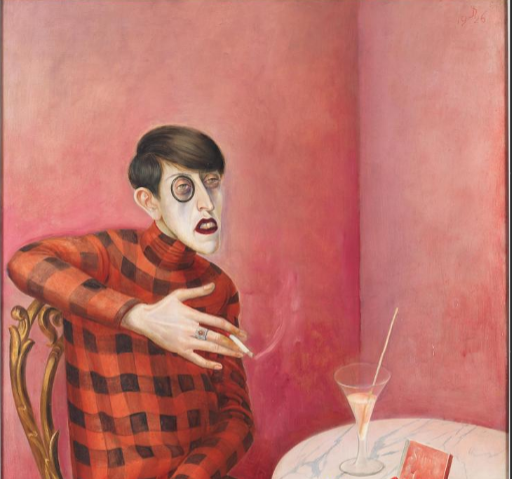
Bildnis der Journalistin Sylvia von Harden (Portrait of the journalist Sylvia von Harden).

At the time, I didn’t really know Otto Dix. Or only vaguely. A name, a few images tied to New Objectivity, to interwar Germany. But standing in front of that portrait, all of that became secondary.
What mattered was the presence.
A woman seated, angular, almost disjointed. Her body slightly turned, her legs crossed in an odd way, one elongated hand resting with an unsettling precision. A monocle. A cigarette. A glass.
And that gaze.
Something extremely lucid. And at the same time, difficult to hold.
You could say Dix exaggerates. That the proportions are distorted, that the body is pushed too far. But that idea doesn’t last very long. It isn’t caricature. It isn’t easy critique either.
It’s something else.
A way of refusing idealization without slipping into mockery.
Otto Dix paints what he sees, but more than that, what he understands. And what he understands clearly isn’t meant to reassure.
Born in 1891, deeply marked by the First World War, in which he served as a soldier, Dix never really came back unchanged. That experience runs through his entire body of work. Not always directly, but like a persistent layer.

In his work, bodies carry something.
A fatigue. A tension. Sometimes a contained violence.
With Sylvia von Harden—a journalist, a figure of Berlin’s intellectual life in the 1920s—he is not trying to seduce. Nor is he trying to openly denounce. He shows.
And what he shows is uncomfortable.
A kind of nervous, almost unstable modernity. A femininity that escapes expected codes. A visible intelligence, but without any flattering staging. Everything feels slightly off, as if the painting refuses to settle into a single, easy reading.
I remember stepping closer, then back, then forward again.
Trying to find a point of balance.
But there isn’t one.
That may be what held me there.
That lack of resolution.
Dix belongs to a very particular moment in German history, when everything feels both intensely alive and deeply fragile. The Weimar Republic, its excesses, its freedom, its tensions. You see this in his portraits, but also in his urban scenes, his prostitutes, his war veterans, his marginal figures.
He beautifies nothing.
He softens nothing.
And yet, he never simplifies.
There is a precision in his work that can feel almost cruel, but without cynicism. A way of pushing the gaze to the point where looking away becomes difficult.

That’s where I find a connection—despite the obvious differences—with certain photographers I’m drawn to. This idea of holding the gaze. Not letting go too quickly. Accepting what unsettles.
With Dix, we are far from any easy notion of beauty. And yet, a form of rightness eventually imposes itself. Not immediately. Not comfortably.
But durably.
What strikes me, thinking back to that portrait at the Centre Pompidou, is that it never tries to please. It makes no effort to seduce the viewer. Instead, it imposes a kind of coexistence.
You are there, in front of this woman, and you have to deal with it.
With a body that doesn’t match expectations.
With a gaze that doesn’t try to welcome you.
With that slightly tense, almost electric atmosphere.
And the longer you stay, the more something shifts.
You stop judging.
You begin to see.

Otto Dix is not a comfortable painter. He doesn’t offer escape. On the contrary, he brings us back to a denser, more ambiguous, sometimes unsettling reality.
But he does so with remarkable rigor.
Every line, every angle, every detail feels deliberate. Nothing is left to chance, even when everything appears unstable. There is a strong construction behind that sense of imbalance.
That may be why the painting stays.
Years later, I can still see it very clearly. The position of the body, the hand, the monocle, the cigarette. And above all, that feeling of having been slightly shifted in the way I look.
Since then, when I come across certain portraits—in painting or in photography—I think of Dix.
Of that demand.
Of that refusal to simplify.
Of that way of showing without explaining.
And I find myself asking, almost instinctively: does it really hold?
Or is it just trying to please?

With Otto Dix, there is no doubt.
It isn’t trying to be pleasant.
It’s trying to be right.
Grégory Herpe


Leave a Reply