Data, players, trends and new frontiers
Based on: Art Basel/UBS 2026 | Arts Economics | Deloitte Private | Christie’s | Sotheby’s | Phillips | Paris Photo 2025
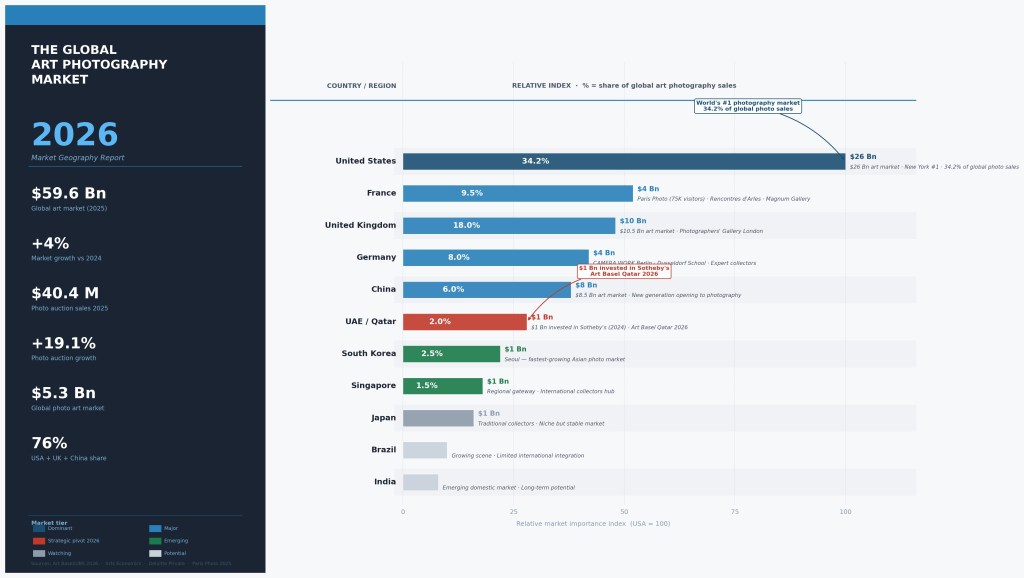
| $59.6 Bn Global Art Market (2025) +4% vs 2024 | $40.4 M Photo Auction Sales (2025) +19.1% vs 2024 | $5.3 Bn Global Art Photography Market All channels combined |
Introduction: A Market in Deep Transformation
For decades, art photography occupied an ambiguous place in the world of collecting: too technical for some painting purists, too reproducible for admirers of the unique object. That era is definitively over.
In 2026, photography is fully integrated into the international art market. The global art market returned to growth in 2025, reaching $59.6 billion according to the Art Basel/UBS 2026 report — a 4% increase after two years of contraction. Within this context, photography stands out with unexpected vigor: auction sales of photographs at Christie’s, Sotheby’s and Phillips totaled $40.4 million in 2025, a 19.1% increase from $33.9 million in 2024. The unsold rate fell to 17.1%, and the average hammer price surged 38.8% to $3.4 million.
These figures mask a more nuanced reality: growth is concentrated on a small number of high-value works. The photography market is not monolithic — it is in fact several overlapping markets: public auctions, specialist galleries, private sales, digital platforms and international fairs, each with radically different dynamics, buyers and pricing logic.
To this is added in 2026 an unprecedented structural upheaval: the eruption of generative AI is reshaping the value attributed to authenticated photographic work. For the first time in its history, documentary photography benefits from a massive comparative advantage — irrefutable proof of human presence, physical risk taken, a gaze situated in reality.
I. Market Geography: Who Collects and Where
The United States, United Kingdom and China account for 76% of global art sales by value. The US market reached $26 billion in 2025, the UK market $10.5 billion, and China $8.5 billion. Photography follows this global geography, but with important country-by-country nuances.
| COUNTRY | POSITION | KEY CHARACTERISTICS | |
| USA | United States | #1 Global — $26 Bn | New York as world capital. Sotheby’s, Christie’s, Phillips. $6.3 Bn in photography (34.2% of global photo market). Adams, Frank, Arbus, Sherman, Crewdson, Eggleston. |
| FRA | France | #2 Europe | Paris Photo (75,000 visitors, Nov. 2025). Rencontres d’Arles. Galleries VU’, Polka, Magnum Gallery (Paris, 2021). Strong attachment to classic 20th-century black and white. |
| DEU | Germany | #3 Europe | CAMERA WORK Berlin (1997). Dusseldorf School: Gursky, Becher x2, Struth, Ruff. Collectors renowned for deep knowledge and loyalty. |
| GBR | United Kingdom | ~18% global market | The Photographers’ Gallery London. Active sales. Interest in both documentary and conceptual. Total art market: $10.5 Bn. |
| KOR/SGP | South Korea / Singapore | Active Emerging | Seoul and Singapore closely watched. New generation of highly connected, young collectors, responsive to contemporary Asian photography. |
| UAE/QAT | UAE / Qatar | 2026 Strategic Pivot | ADQ invested $1 Bn in Sotheby’s in 2024. Art Basel Qatar and Frieze Abu Dhabi launched in 2026. The Gulf becomes a new global hub. |
| CHN | China | Selective — $8.5 Bn | Preference for Chinese contemporary art. But a new generation in Beijing, Shanghai and Hong Kong is opening up to international photography. |
| BRA/IND | Brazil / India | Unrealized Potential | Dynamic local scenes but little connection to the international photography market. Markets to watch over 5-10 years. |
II. Market Infrastructure: Who Sells and How
A. Auction Houses
Public auctions are the most visible segment but represent a minority share of total value exchanged. The bulk of photographic transactions occur privately, through galleries or private sales.
The three major players — Christie’s, Sotheby’s and Phillips — each hold dedicated photography sales, primarily in New York and London. In 2025, their combined photography sales reached $40.4 million, up 19.1%. Phillips remains historically the most specialized of the three.
| Artist | Work | Price | House / Date |
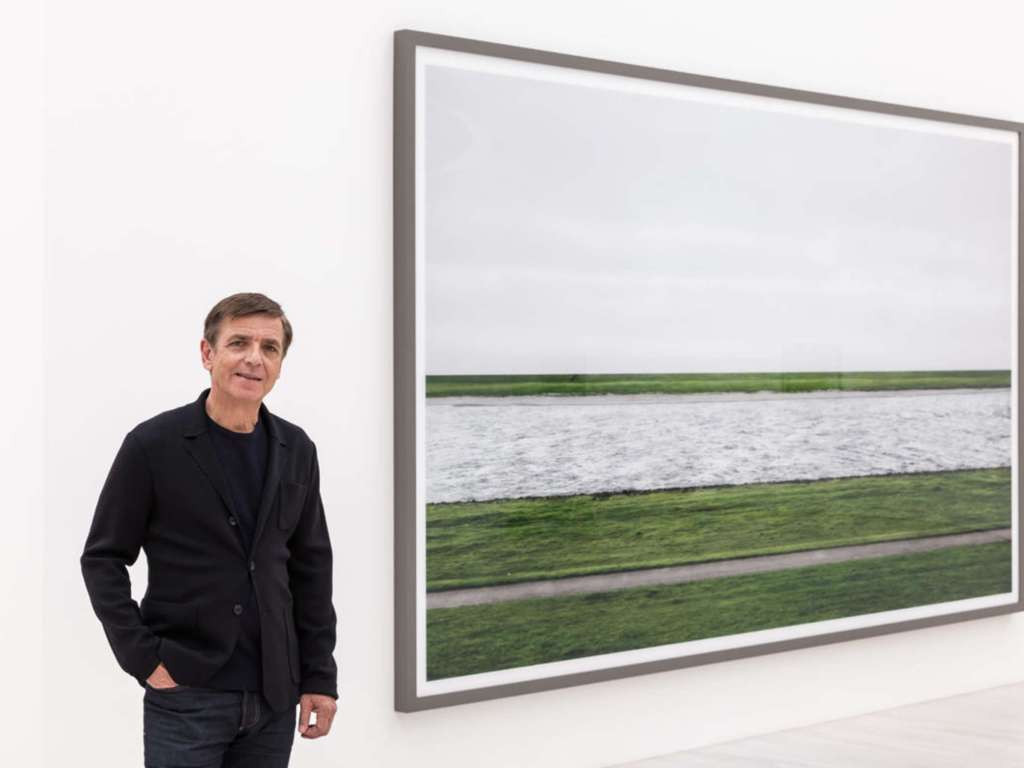
| Andreas Gursky | Rhein II (1999) | $4.3 M | Christie’s NY, 2011 — Absolute record |
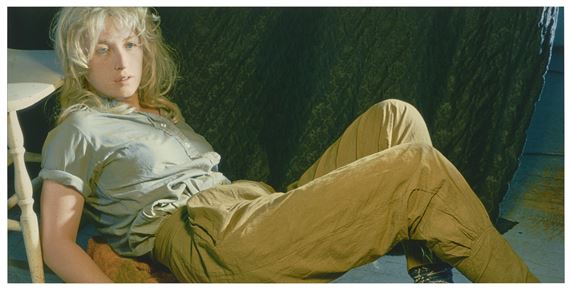
| Cindy Sherman | Untitled — personal record | $3.89 M | Christie’s NY, 2022 |
| Man Ray | Noire et blanche (1926) | $2.8 M | Sotheby’s NY, 2025 |
| Cindy Sherman | Untitled Film Still #13 | $2.3 M | Christie’s, 2025 |
| William Eggleston | Los Alamos (101 prints) | $1.9 M | Phillips NY, 2025 |
| Cindy Sherman | Untitled #94 (1981) | $806,400 | Christie’s, Nov. 2024 |
| Andreas Gursky | NY Mercantile Exchange | GBP 609,600 | Phillips London, Oct. 2024 |
| Fox Talbot | Salt print, 1840 | $650,000 | Paris Photo / H.P. Kraus, 2025 |
The absolute record of $4.3 million for Gursky’s Rhein II (Christie’s, 2011) remains the highest price ever achieved in public sale for a photograph. Recent Gursky and Sherman works in 2024-2025 sold between $600,000 and $900,000, confirming their blue-chip status without approaching their historical peaks.
B. Specialist Galleries: The Backbone of the Market
The gallery market represents the majority of photographic transactions by value but remains less documented than auctions. Key structural players:
- Gagosian (19 locations worldwide) — The most powerful megadealer. Richard Avedon, Diane Arbus, Cindy Sherman, Nan Goldin, Sally Mann in its roster. Unmatched ability to position a photographic work at the level of the best contemporary paintings.
- Pace/MacGill Gallery (New York) — Over 350 photography exhibitions since 1983. An absolute reference for modern and contemporary American photography.
- CAMERA WORK (Berlin, 1997) — One of the world’s finest photography galleries. Fashion photography, documentary, contemporary German school.
- Magnum Gallery (Paris, 2021) — The cooperative founded in 1947 by Capa, Cartier-Bresson, Seymour and Rodger now has a physical space in Paris for its artist prints and estates.
- The Photographers’ Gallery (London) — The largest public gallery dedicated to photography in Europe. A reference venue for institutional exhibitions and the secondary market.
- Galerie VU’, Polka (Paris) — Major players in the French documentary and photojournalism scene. Important tastemaker role for emerging photographers.
C. Private Sales — A Major 2026 Trend
Art Basel identifies the rise of private sales as one of the six structural trends of 2026. For works above $100,000, both sellers and buyers increasingly prefer the discretion of a private transaction. Major works now circulate between collectors without ever reaching a public auction room, often through an art advisor or established gallery.
D. Online Platforms
The rise of digital platforms has profoundly changed market access. Auction sales of lots under $5,000 grew 7% in 2025, confirming a healthy entry-level market.
- Artsy — Global online leader. Gallery subscription ~$450/month + ~15% commission. Most active in the $5,000-$100,000 range.
- Saatchi Art — 35% commission. Accessible to artists without a gallery. High traffic for works between $500 and $5,000.
- 1stDibs — Luxury platform. Ideal for vintage prints and works above $10,000. Over 85,000 photographic works available.
- Singulart — Strong European growth. Well-positioned with French and German collectors.
E. International Fairs
- Paris Photo (Grand Palais, November) — The most important photography fair in the world. 2025 edition: 75,000 visitors. Top sale: $650,000 for a Fox Talbot salt print from 1840 (Hans P. Kraus). 39% women photographers represented (vs. 20% in 2018). Digital sector confirmed for its 3rd edition.
- Art Basel (Basel, Miami Beach, Hong Kong, Qatar in 2026) — The world’s most powerful art fair. Photographic art increasingly present in major gallery stands.
- AIPAD Photography Show (New York) — Show exclusively dedicated to photography, organized by the Association of International Photography Art Dealers.
- Rencontres d’Arles (summer) — The reference festival and market for contemporary and documentary photography. Essential entry point for European collectors.
- Frieze (London, New York, Seoul, Abu Dhabi in 2026) — Growing photography presence, particularly for artists working at the intersection of conceptual and documentary.
III. Photographers: Established Values and Market Logic
A. Blue-Chip Artists on the Secondary Market
- Andreas Gursky — Absolute record: $4.3M (2011). Major 1990s-2000s works: between $500,000 and $1.5M.
- Cindy Sherman — Personal record: $3.89M (2022). Active and liquid market between $300,000 and $800,000.
- William Eggleston — Father of color art photography. Prices between $100,000 and $1.9M for major suites.
- Richard Avedon / Irving Penn — Author fashion photography. Signed vintage prints can exceed $500,000.
- Nan Goldin — Institutional recognition (MoMA, Tate) + activist engagement. Active market between $50,000 and $400,000.
- Sebastiao Salgado — Major documentary projects (Genesis, Workers, Migrations). Reference prints between $80,000 and $250,000. Iconic works reaching or exceeding $150,000.
- Diane Arbus — Very active estates market, strong institutional demand. Vintage prints between $100,000 and $800,000.
B. Print Logic: What Every Photographer Must Understand
| Vintage vs. Modern — Edition — Authenticity: The Three Value Variables |
| Vintage print: made during the photographer’s lifetime and contemporary with the shoot. Maximum value — often 5 to 20 times higher than a modern print. |
| Modern print (posthumous or late): made by the estate or photographer long after the shoot. Significantly lower value. |
| Numbered limited edition: the market strongly rewards scarcity. An edition of 3 + 2 AP is worth far more than an edition of 30. (Eggleston lost a lawsuit in 2012 for printing identical works in large format after selling rights to a limited edition.) |
| Certification and provenance: in 2026, with the rise of AI, traceability of a work — bill of sale, certificate of authenticity, provenance file — has become a key buying criterion for serious collectors. |
IV. The Six Trends Reshaping the Market in 2026
1. The Authenticity Economy — Documentary Photography’s Unprecedented Advantage
This is the most structurally significant trend of 2026. The explosion of generative AI has triggered a deep reaction among collectors: an increasingly urgent demand for works whose human authorship is irrefutable. The image of conflict, migration, or collective memory cannot be reproduced by an algorithm. It carries within it the trace of physical commitment, risk taken, years spent in the field.
Digital art now accounts for 13% of high-net-worth collectors’ portfolios (up from 3% in 2024), but this growth is accompanied by increased discrimination: collectors clearly distinguish between works with established human authorship and algorithmic productions. Documentation of the creative process has become a constitutive element of value.
2. The Resurgence of Documentary and Humanist Photography
After a decade dominated by very large conceptual formats and abstract photographs, collectors are rediscovering visual narrative. Works embedded in a coherent documentary project built over several years are more appealing than ever. At Paris Photo 2025, stands specializing in humanist documentary photography recorded particularly high sell-through rates.
Classic humanist photography (Doisneau, Boubat, Ronis) continues to attract French collectors. But it is contemporary documentary photography — armed conflicts, migrations, memories of marginalized groups, urban transformations — that is seeing the strongest growth, especially when it forms part of a recognized, coherent body of work.
3. The Rise of Digital Art and Photography NFTs
The NFT photography market reached $1.12 billion in 2024, with projected growth of 24.7% per year through 2033. In Europe, the expected growth rate is 23.1% per year. In 2026, NFTs function primarily as digital certificates of authenticity and entry points into virtual or immersive exhibition experiences.
51% of wealthy collectors acquired a digital artwork in 2024 or 2025. Digital art is now the third segment by value, behind painting and sculpture. Art Basel will deploy its Zero 10 digital art platform across its Hong Kong and Basel editions in 2026.
4. Experience as a Buying Value
Buyers are increasingly choosing experiences over objects. Global spending on luxury hospitality is expected to exceed $390 billion in 2028. For the photography market, this translates into greater value placed on exclusive access moments: prints signed at meetings with the photographer, trips linked to a documentary project, private exhibitions in exceptional venues. The personal relationship between photographer and collector becomes a tangible asset.
5. The Middle East: New Global Market Pivot
ADQ’s (Abu Dhabi Development Holding Company) $1 billion investment in Sotheby’s in 2024 materializes the region’s ambition. In 2026, Art Basel launches its fair in Qatar and Frieze opens in Abu Dhabi. Gulf collectors, long oriented toward Islamic art, are progressively opening up to international contemporary practices — including documentary photography dealing with identity and conflict in the Arab world.
6. Intergenerational Wealth Transfer and New Collectors
The intergenerational wealth transfer underway — estimated at over $83 trillion in the coming decades — is one of the structural facts of the art market for the next 20 years. Heirs are younger, more international, more female and significantly more receptive to photography. This new generation discovers art on Instagram before seeing it in a gallery, buys first works online, and prizes the photographer’s ethical commitment.
V. What This Means for a Documentary Photographer
| The 2026 market values three things AI cannot produce |
| 1. Physical presence and risk taken: being there — in the conflict zone, the refugee camp, the forgotten neighborhood. |
| 2. Duration: a documentary project built over 5, 10 or 15 years demonstrates a commitment no algorithm can simulate. |
| 3. Ethical relationship: the connection to the photographed subject, consent, community restitution — proof of an irreducibly human practice. |
- Build a coherent body of work — Collectors and galleries look for complete series, not isolated images. A documentary project of 40 to 80 prints on a single subject has more market value than an eclectic selection.
- Control your edition policy — Limit prints to editions of 5 + 2 AP maximum for larger formats. Document every print with a certificate of authenticity and a numbered register.
- Target intermediate fairs before Paris Photo — Rencontres d’Arles, emerging European festivals, gallery shows in Germany or Scandinavia: build recognition progressively.
- Develop your presence on Artsy and Saatchi Art — Even without a gallery, these platforms generate international visibility and reach North American and Asian collectors.
- Document your process carefully — In 2026, demanding collectors want to know how an image was made. A field journal, a well-written statement, process documentation have become constitutive elements of value.
- Cultivate relationships with documentary-specialist galleries — Magnum Gallery, Galerie VU’, Polka, CAMERA WORK and their equivalents are the best vectors of access to serious institutional and private collectors.
Conclusion
The global art photography market in 2026 is robust, growing (+19.1% at auction), but deeply selective. Price concentration among a small number of established artists remains the rule in the high-end segment, while the accessible middle market is expanding through digital platforms and new generations of collectors.
The convergence of several simultaneous phenomena creates a paradoxically favorable moment for documentary photography: generative AI reshuffles the cards in favor of proven authenticity, intergenerational wealth transfer brings buyers sensitive to social and ethical questions, and the return of strong visual narrative signals the exhaustion of purely decorative or formal photography.
In this context, photographers whose work embodies a coherent, documented, long-term ethical approach have a structural advantage they did not have ten years ago. It is no longer technique or format that dictate value, but depth of vision and the irreducibility of human presence in the image.
That is precisely what no machine, no algorithm, will ever be able to manufacture.
Grégory Herpe
Sources & References
Art Basel & UBS — The Art Market 2026 (Arts Economics, March 2026). Key data: global market $59.6 Bn, +4% growth, US/UK/China breakdown, six trends for 2026.
Deloitte Private — Photography Market Report 2025. Auction sales: $40.4M (+19.1%). Unsold rate: 17.1%. Average hammer price: $3.4M (+38.8%).
Paris Photo 2025 — Official report, Grand Palais, November 16, 2025. 75,000 visitors. Top sale: $650,000 (Fox Talbot, 1840). 39% women represented.
Collector Daily — Year in Review: Top 10 Highest Priced Photography Lots at Auction in 2024.
DataIntelo / Coherent Market Insights — NFT Photography Market. Market size: $1.12 Bn (2024). Projected CAGR: 24.7% (2025-2033).
Artsy / Christie’s / Sotheby’s / Phillips — Auction results 2024-2025 (Man Ray, Cindy Sherman, William Eggleston, Andreas Gursky).
The Art Newspaper — Global art sales grew 4% in 2025 but remain below pre-pandemic levels, March 12, 2026.
Art News — After Two Years of Decline, the Art Market Edges Back to Growth, Says 2026 Art Basel UBS Report.

Leave a comment