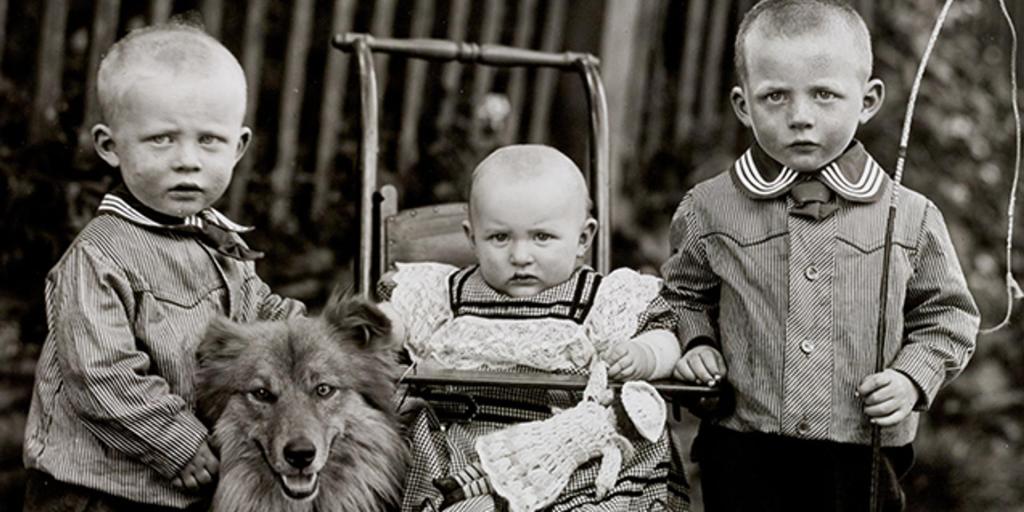
“Without observation, no knowledge of the world is possible, and no photograph can lie if the lens is accurate and the operator skilled and honest.”
— August Sander
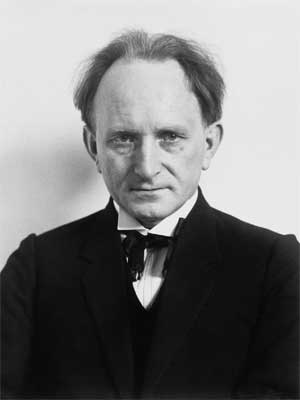
A Son of the Rhenish Earth
August Sander was born on November 17, 1876, in Herdorf, a mining village in the Westerwald massif, deep in the Rhineland. His father was a carpenter at the local iron mines. It was in this working-class world, between forests and mine shafts, that Sander first picked up a camera — a large-format plate camera that the young teenager cobbled together with the help of a neighboring miner, Carl Jung, who gave him one. He was fourteen years old. Photography was not yet a calling: it was first and foremost a child’s fascination with light and mechanics.
After his military service, he traveled Germany as an itinerant photographer’s assistant — Berlin, Magdeburg, Halle, Dresden. He trained in commercial studios, learning portrait techniques, studio lighting, and the demands of bourgeois clientele. In 1902, he settled in Linz, Austria, where he opened his own studio. There he met Anna Seitenmacher, whom he would marry. The studio flourished. Critics began to notice his work: he won several prizes at international exhibitions.
But Sander was not built for the comfort of a studio. In 1910, he returned to the Rhineland and settled in Cologne. It was there, in that industrial city at the crossroads of modern Germany, that he would conceive the most ambitious project of his life.
Menschen des 20. Jahrhunderts — A World-Work
Around 1911, Sander began sketching an idea that had no precedent in the history of photography: to build a systematic, exhaustive portrait of the German people. Not the great men, not the celebrities, not the powerful — but everyone. The farmer, the craftsman, the solicitor, the civil servant, the maid, the unemployed worker, the revolutionary, the pastor, the beggar. A visual taxonomy of German society, organized not alphabetically or chronologically, but by social type, by human category.
He called this monumental project Menschen des 20. Jahrhunderts — “People of the Twentieth Century.” He conceived it as an atlas of German humanity, structured around seven broad sections:
- The Farmer — man rooted in the earth
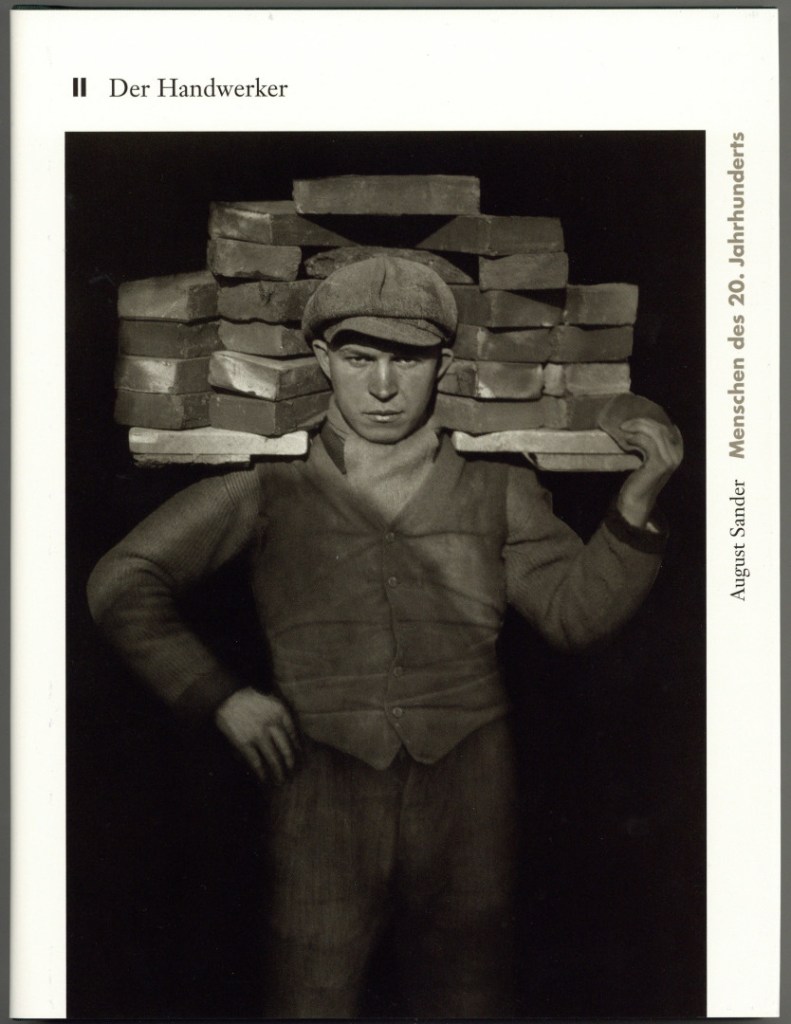
- The Skilled Tradesman — the qualified worker, builder of the real world
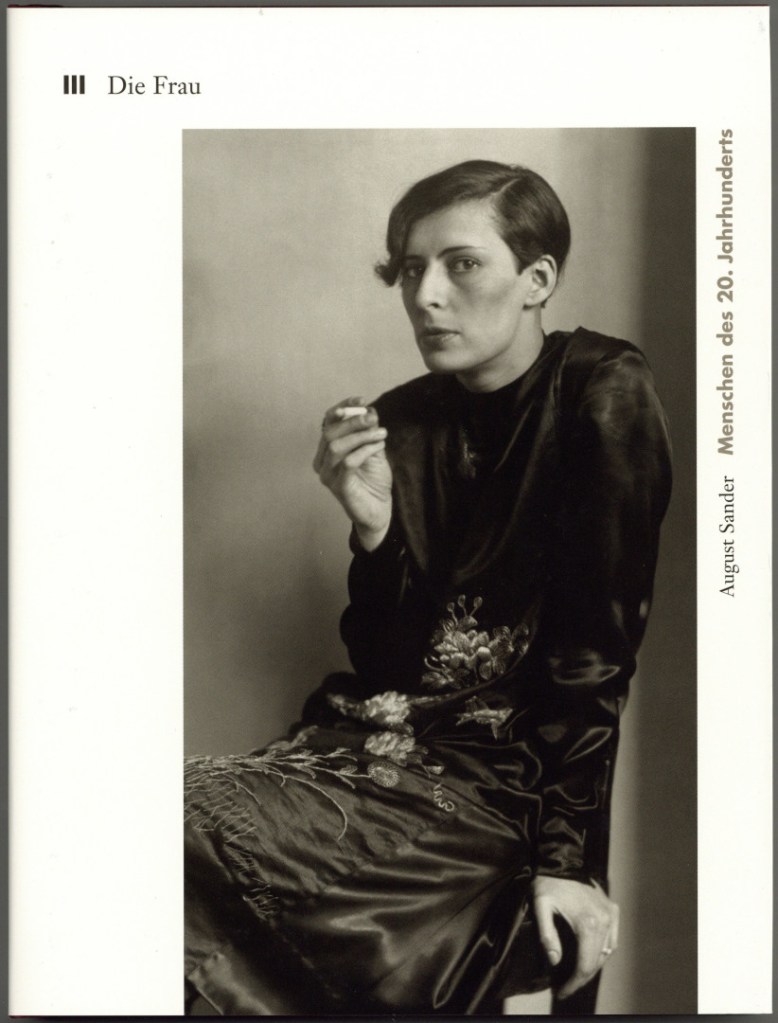
- The Woman — in her multiple social roles
- Classes and Professions — from the civil servant to the upper bourgeoisie
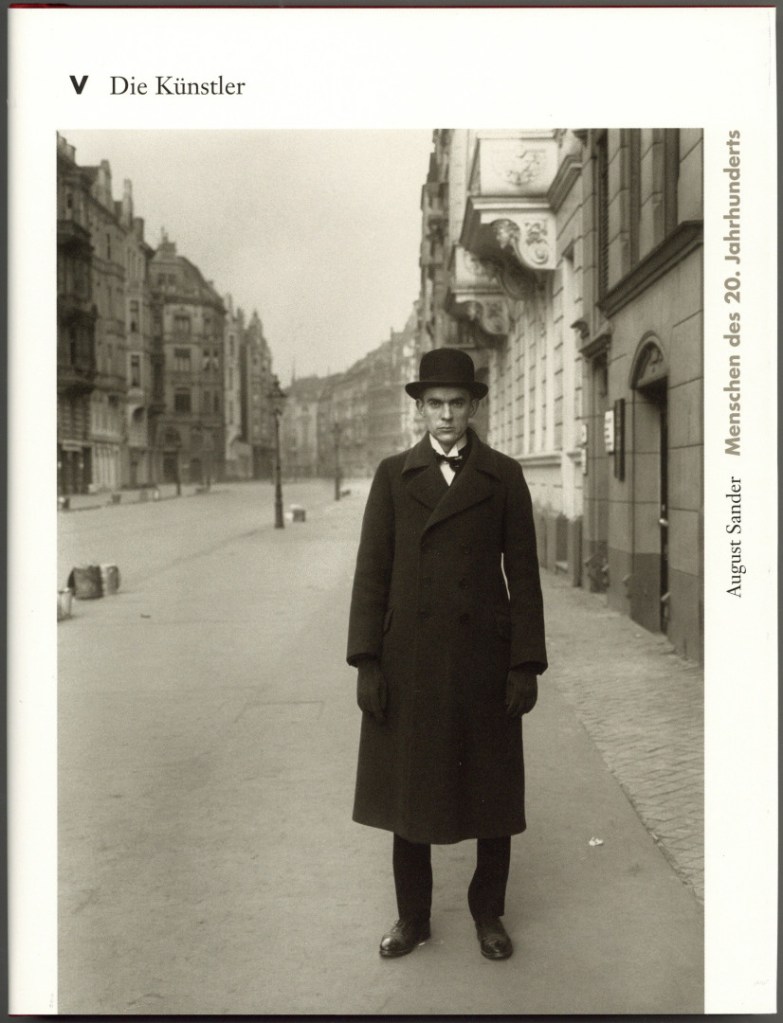
- The Artists — painters, musicians, poets, architects
- The City — the urban world and its figures
- The Last People — the excluded, the sick, the vagrants, the dying

This classification was not naive. It was deeply influenced by the ideas of painter Franz Wilhelm Seiwert and the progressive Cologne circle, aligned with the Neue Sachlichkeit — New Objectivity — movement, which rejected expressionism and abstraction in favor of clear, frontal, unadorned figuration. Sander shared this conviction: reality, faced head-on, without pretense or embellishment, is more powerful than any artistic artifice.
His method never varied. He went to his subjects — to their farms, their workshops, their apartments, their factories. He photographed them in their natural environment, with their tools, their work clothes or Sunday best, their spontaneous or slightly composed poses. No fabricated backdrops. No makeup. No theatrical staging. The subject stood before the lens, and Sander waited: for the moment when the person simply was themselves — neither too stiffened by awareness of the pose, nor too relaxed to lose their dignity.
The result is an almost hypnotic frontality. Sander’s people look into the lens — and therefore at us — with an unsettling directness. They are not posing: they are bearing witness.
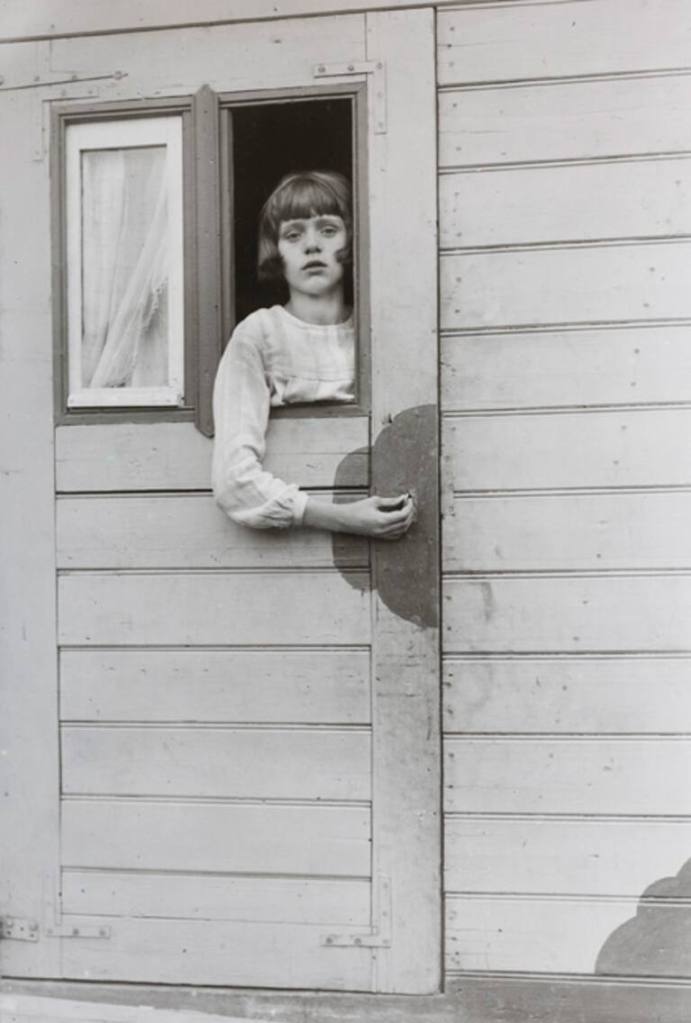
1929: Face of Our Time
In 1929, Sander published Antlitz der Zeit — “Face of Our Time” — the first installment intended to introduce his project to the public. Sixty photographs, selected from thousands of negatives. The book was a revelation. Critics were unanimously enthusiastic. Alfred Döblin, author of Berlin Alexanderplatz, wrote the preface with striking clarity: “There is a comparative science of man… Sander’s photography is a kind of sociology in images.”
The book landed in a Weimar Germany in full intellectual ferment but also in full political disintegration. The faltering Republic, the rise of nationalism, the economic crisis of 1929 striking with full force — all of this formed the backdrop against which these faces of Rhenish peasants, communist workers, upper-bourgeois ladies, clowns, and homeless people took on a tragic dimension.
The Nazi Catastrophe
When Hitler came to power in 1933, August Sander was already famous. But his fame did not protect him — it exposed him.
The Nazi regime had a racial and ideological vision of the German people that had nothing to do with Sander’s universal, humanist gaze. Antlitz der Zeit was seized and destroyed by the authorities in 1934. The printing plates were smashed. The book vanished from libraries.
His son Erich, a socialist activist, was arrested in 1934. He was sentenced to ten years in prison and died in his cell in 1944, just weeks before the end of the war, from an untreated appendicitis — or perhaps murdered; the archives remain incomplete. It was the deepest wound of Sander’s life.
August continued to work quietly. He retreated to politically safer subjects: Rhineland landscapes, monuments, nature. He packed his portraits into boxes, protected them, hid them. In 1944, a fire during an Allied bombing raid on Cologne destroyed a large part of his prints. He saved what he could and took refuge in the Westerwald, the land of his childhood.
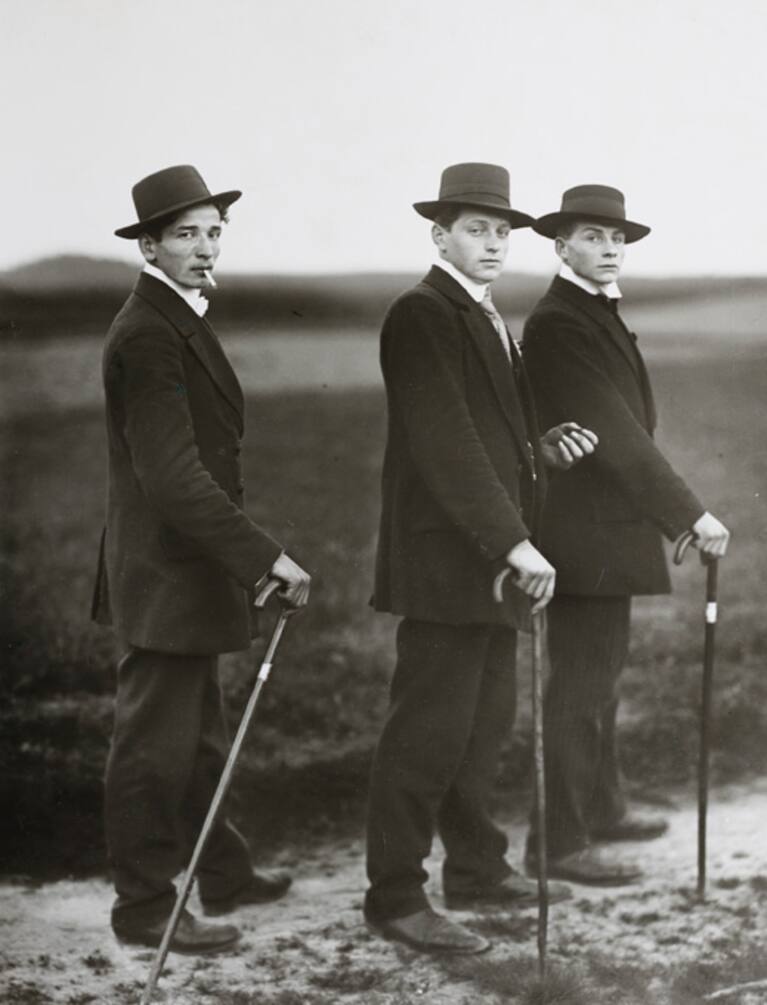
The Postwar Renaissance
After 1945, Sander was an old man approaching seventy — ruined, bereaved, but his vision intact. He resumed his classification system, attempting to reconstruct his work from the surviving negatives — approximately ten thousand glass plates had survived, a relative miracle.
Belated recognition came. In 1951, Edward Steichen included him in a major exhibition. In 1955, he appeared in The Family of Man, the landmark MoMA exhibition in New York that brought together 503 photographs from 68 countries around the idea of a universal humanity. Sander’s portraits moved audiences worldwide.
He died on April 20, 1964, in Cologne, at the age of 87. His work was far from fully published. It was his son Gunther, and later the foundation created in his name, who would continue the work of cataloguing and dissemination.
The Influence — A Long Wave
Sander’s influence on twentieth-century photography is deep, far-reaching, and often unconscious in those he shaped.
Diane Arbus is perhaps the photographer who owes him the most openly. Her portraits of people on the margins — dwarfs, cross-dressers, twins, nudists — inherit directly from Sander’s approach: going to the other in their own space, photographing them with a frontality that refuses the picturesque. Arbus said that photography must show what we are not supposed to look at.
Walker Evans, with his project Let Us Now Praise Famous Men (1941), shared with Sander the same documentary impulse and the same dignity extended to the dispossessed. The Alabama sharecroppers gaze into Evans’s lens the way the Westerwald peasants gazed into Sander’s.
Richard Avedon, late in his career, with his series In the American West (1985), explicitly reproduced Sander’s structure: anonymous individuals, photographed head-on against a neutral background, carriers of a social truth long eclipsed by the glamour of his fashion work.
Thomas Ruff, a member of the Düsseldorf School trained by Bernd and Hilla Becher, pushed Sander’s logic toward abstraction: his large-format portraits from the 1980s are impassive faces on neutral backgrounds that interrogate the very idea of photographic neutrality.
The Düsseldorf School as a whole — Candida Höfer, Andreas Gursky, Thomas Struth — inherits Sander’s systematic rigor and seriality, transposed to architecture and public space.
The Legacy Today
In an era of social media and image overproduction, August Sander appears paradoxically more relevant than ever.
His project raises questions at the heart of contemporary debates about photography: what does it mean to represent the other? Can one claim objectivity? Is categorizing individuals by their social or professional belonging a liberating framework or a reductive one? Sander believed that society could be read in faces. Today, we understand that this reading is also the photographer’s own — his choices of framing, light, and moment construct as much as they reveal.
The August Sander Foundation, based in Cologne, continues to publish previously unseen volumes of Menschen des 20. Jahrhunderts. The project has never been published in its entirety — and perhaps never will be, so overreaching was the original ambition. That may be its greatest quality: a work that always exceeds the frame assigned to it.
Major retrospectives have been devoted to him in recent years at MoMA, the Centre Pompidou, and the Tate Modern. Each time, the audience’s reaction is the same: silence before these faces from the last century, a strange feeling of being looked at in return.
For that may be Sander’s ultimate genius. He wanted to photograph the Germans. He photographed everyone.
Grégory Herpe


Leave a comment