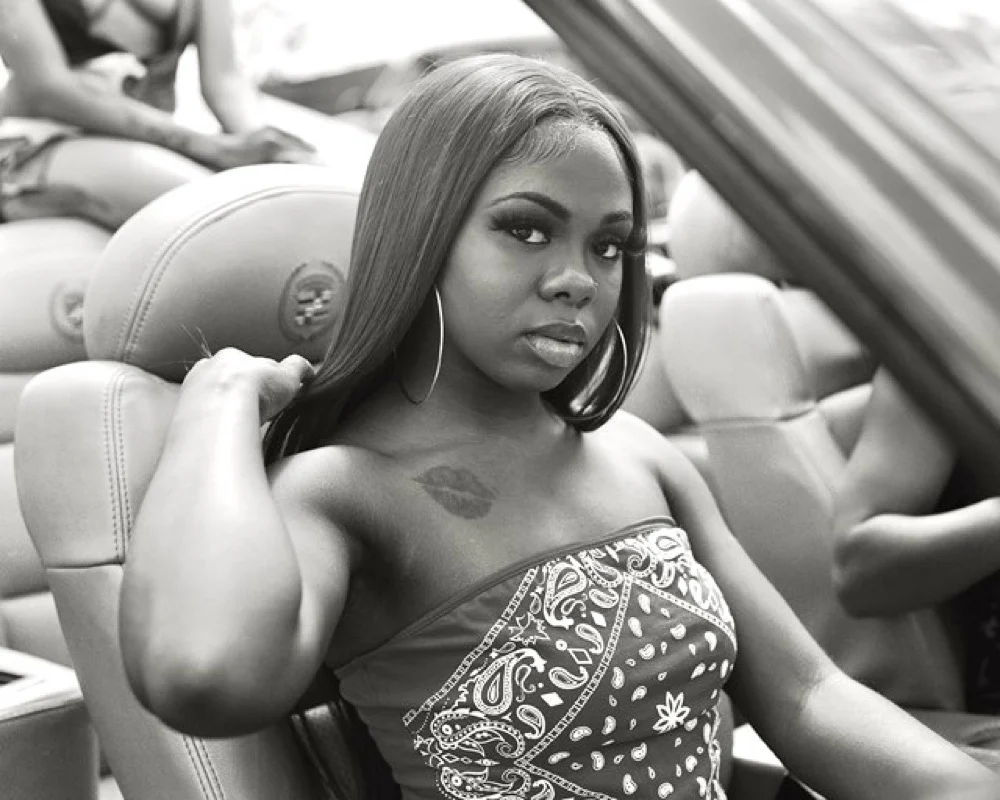
Rahim Fortune didn’t go to photography school. He skated. He played in bands. He hung around. And one day he had a camera in his hands and started making pictures of his friends because his friends were cool and the light in Texas is something you simply cannot ignore if you have eyes in your head.
He grew up between Kyle — a charmless suburb south of Austin, the kind of place everyone wants to leave — and Tupelo, Oklahoma, in the Chickasaw Nation, at his mother’s. Double heritage: his father is African American, his mother is Chickasaw. She died in 2007. Fortune is thirteen. He doesn’t have film in his hands yet, but there’s already something in his eyes that reaches very far.
- He meets Eli Reed. If that name means nothing to you, stop everything and go find Beirut: City of Regret. Eli Reed is Magnum, is Black American photojournalism at its strongest. Fortune becomes his assistant. He learns in the real world, not in a classroom with studio lights and a professor who stopped making pictures fifteen years ago. Around the same time, he gravitates toward the Kamoinge Workshop — a collective of Black photographers founded in Harlem in 1963, a direct and somewhat furious response to the systematic exclusion of Black artists from American photographic institutions. Wayne Lawrence is a member. Fortune watches, absorbs, takes notes.
He also enrolls in sociology at CUNY in Manhattan, because he understood early enough that the camera alone isn’t enough if you haven’t figured out the world you’re pointing it at. That kind of clarity is rare. Most photographers figure that out at forty. He already knew.

His references say everything. Earlie Hudnall Jr — a Houston photographer who spent his entire life documenting the Black community of Texas with a tenderness that even his toughest pictures can’t conceal. Dorothea Lange, Russell Lee, the Farm Security Administration generation — people sent out during the Great Depression to put a human face on American misery, and who changed documentary photography forever. And Consuelo Kanaga, civil rights photographer, whose portraits carry an emotional weight that stays with you for days.
Fortune doesn’t drop these names to legitimize himself in a magazine bio. He places himself in a real lineage, a tradition of people who used photography for something specific: making visible what power would rather not see.
He shoots in black and white. 6×7 format. Film. And no, this is not analogue fetishism, not the hipster who scrolled too much on Flickr. It’s a choice that costs — money, time, attention. The 6×7 forces you to see before you shoot. You don’t get to fire off 400 frames and sort through them later. You’re there, you look, you wait. You build something with the person in front of you before you even touch the shutter. And that — you feel it in every single one of his images — that sense that Fortune was there long before the photograph existed.
First book, 2020. Oklahoma. He returns to the Chickasaw Nation, photographs elders and young people in intertribal regalia — the pow-wow dress that is both living tradition and political statement. These images could have been ethnography dressed up as art, photographic tourism with good intentions. We’ve all seen it. With Fortune, none of that. People look straight into the lens without asking anything from anyone, with a dignity that needs no explanation. This is that extremely rare thing in photography: images that don’t take people — they give them back.

Then 2020 turns into a nightmare — for him and for the world at the same time. His father falls ill. He goes back to Texas to take care of him. Lockdown descends. George Floyd dies in Minneapolis. The country burns. And Fortune, in the middle of all of it, makes pictures. His Black artist friends in Austin. Bodies, faces, people trying to hold on to something that looks like grace in a moment when grace is extremely expensive.
I Can’t Stand to See You Cry comes out in 2021 on Loose Joints. It’s his most devastating book. Nominated for the Paris Photo–Aperture Photobook of the Year. Winner of the Rencontres d’Arles Louis Roederer Discovery Award 2022. Arles — the old festival, the consecration. For a kid from Kyle, Texas, who skated and didn’t necessarily think he’d end up in collections.
Sometime after, he crosses paths with descendants of the Buffalo Soldiers in Austin. These Black soldiers who fought for an America that otherwise refused to treat them as citizens — the kind of irony American history produces on a rolling basis. And he hears the word for the first time: hardtack. Unleavened bread, flour water salt, survival ration during the Civil War. The thing that doesn’t rot, that lasts for years, that still feeds you when everything else has long since fallen apart.
Fortune latches onto that word like his life depends on it. And in a way, it does.

Hardtack comes out in 2024, still on Loose Joints. Ten years of work in a single book — assignment images for the New York Times woven together with his personal practice, landscapes of Texas and Oklahoma, portraits, close-ups, textures. The book doesn’t try to get around something. It tries to stay inside it. Inside the tenacity of Black Southern cultures against two centuries of attempted erasure. The title has that quality — concrete, humble, ducking all the grand words. Not Heritage, not Roots, not Memory. Hardtack. A ration. Something that holds.
Shortlisted for the Deutsche Börse Photography Foundation Prize 2025, alongside Cristina De Middel, Tarrah Krajnak, and Lindokuhle Sobekwa. A list that says something important about where photography is headed right now. And honestly, that’s good news.

What makes Fortune impossible to slot into a category — and God knows magazines love their categories — is that he doesn’t come from the outside to document a community with his beautiful project and his freshly ironed conscience. He comes from the inside. With loss in him, love, complexity. His images don’t look like documentation because they aren’t documentation. They look like someone trying not to forget.
He once said he wanted his work to offer “a sense of visibility or healing.” Visibility and healing. Two words that sound simple enough, but are actually the most ambitious program you can set for yourself in photography. And he pulls it off.
Rahim Fortune is thirty-one years old. He’s still warming up.
Grégory Herpe

His work is on view right now at the California African American Museum (CAAM) in Los Angeles, as part of the exhibition Between a Memory and Me — through September 5, 2026. You have time. But not that much.

Leave a Reply