Photographic film is back. But back from where, exactly?
There’s something strange, almost dizzying, about watching a generation born with an iPhone in its pocket chase rolls of Kodak Gold 200 as if they were solid gold. And not metaphorically—the price of film has doubled, sometimes tripled, in under a decade. A 36-exposure roll that cost 4 euros in 2015 easily goes for 12 today. Darkrooms and labs, which we assumed were doomed to vanish like phone booths, are reopening. Factories are relaunching emulsions no one thought they’d see again. Something is happening. But what, exactly?
The question isn’t trivial. Because behind the “film photography” phenomenon lie at least two very different things, not always honest with each other. On one side, a genuine aesthetic and philosophical resistance, carried by people who’ve thought seriously about what it means to make an image when everyone else is making ten thousand a year. On the other, a marketing operation of formidable efficiency, one that has managed to turn constraint into desire, limitation into luxury, flaw into signature.
Both coexist. And that’s where it gets interesting.
The announced death, and what happened after
To understand the comeback, you first have to grasp the scale of the collapse. In 2003, Kodak was still selling 800 million rolls of film a year worldwide. In 2011, the company that had invented Kodachrome, that had colorized the twentieth century, filed for bankruptcy. Kodachrome film itself had been discontinued in 2009. The last lab in the world authorized to develop it, Dwayne’s Photo in Parsons, Kansas, processed its final roll on December 30, 2010—a roll sent in by photographer Steve McCurry. (Steve McCurry, the man behind the portrait of Sharbat Gula, the green-eyed “Afghan Girl” of National Geographic, one of the most viewed photographs of the twentieth century.) The loop closed neatly.

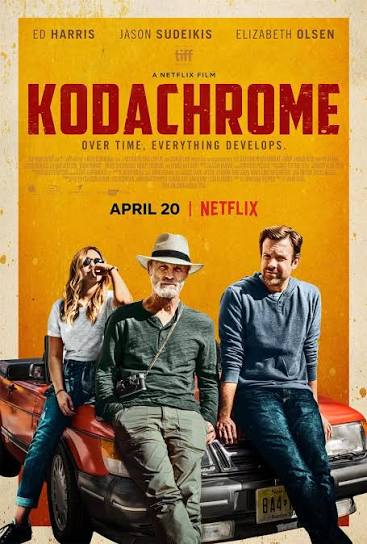
The excellent film Kodachrome, by Mark Raso, starring the brilliant Ed Harris as an old photographer driving cross-country to the last lab to develop his final rolls, echoes this reality rather closely. Watch it—it’s genuinely moving.
Fujifilm discontinued dozens of emulsions between 2010 and 2020. Factories closed one after another. Ilford, the British black-and-white giant, had nearly disappeared in 2004, saved at the last minute by a buyout led by its own employees. The industry seemed condemned by an unanswerable logic: digital was better, cheaper, faster, more convenient. Who would choose to do worse?
And then something broke in that logic.
Around 2012–2013, film sales stopped falling as fast. By 2016, they had started climbing again. Timidly at first, then with an energy that surprised everyone, manufacturers included. In 2019, Ilford announced rising production figures for the first time in twenty years. Kodak Alaris relaunched Ektachrome E100 in 2018—a color slide film nobody really expected, which promptly sold out. Film Ferrania, a small Italian manufacturer whose roots go back to 1923, pulled off a $300,000 crowdfunding campaign in 2015 to relaunch a color film. The factory had sat abandoned for fifteen years.
This is not an accident.

Grain as language
To understand film’s return, you have to understand what digital did to the image.
Digital made photography clean. Too clean. Modern sensors—especially since the arrival of smartphones with built-in image-computing systems (what’s called “computational photography”)—produce images with a sharpness, dynamic range, and crispness the best cameras of the 1990s couldn’t approach. A recent iPhone photographs better in low light than a professional Nikon from the year 2000. That’s objectively true. It’s also, for many photographers, a problem.
Because an image that’s too perfect says something strange about time. It belongs to no particular moment. Digital perfection is timeless—or rather, it erases time, freezing the instant in a resolution so high it becomes almost unreal. Film grain, by contrast, belongs to a moment. It’s the chemical trace of light that struck an emulsion at a precise place, at a precise second. It’s physical, irreversible, unique.
French photographer and theorist Roland Barthes put his finger on something essential in Camera Lucida (1980): photography is tied to time in a way no other image can claim. It says “that has been.” Not “that resembles,” not “that represents.” “That has been.” Grain reinforces this “that has been”; it is its chemical signature.
Do the young photographers loading a roll of HP5 into a Pentax K1000 bought off Leboncoin think about Barthes? Probably not. But they feel something of that order. Something to do with resisting the smooth, retouched, filtered, augmented image—the Instagram image that never had a negative, that never existed in the physical world, that was born and will die on a server somewhere.
Film, on the other hand, exists. You can hold it. You can lose it in a fire. It has a biology.
The marketing of the real
But here’s where it gets complicated. Because this desire for authenticity was immediately captured by industry and turned into a reproducible aesthetic—and therefore into merchandise.
Lomography, the Austrian brand founded in 1992 and named after a cheap Soviet camera (the LOMO LC-A), pioneered this move. As early as the 1990s, Lomography sold film and its accidents—light leaks, saturated colors, vignetting—as a philosophy. “Don’t think, just shoot.” An anti-aesthetic that became its own academicism. Instagram filters that simulate Kodachrome, Lightroom presets that add grain, apps that reproduce film’s “flaws”—all of it says the same thing: the desire for the chemical trace is real, but it can be simulated, sold, packaged.
The result is a paradox. Demand for real film is partly driven by an aesthetic people first encountered through digital. They saw “film” filters on their screens, found them beautiful, and now want the original. It’s a bit like falling in love with a vinyl record because you heard a sample of it in a hip-hop track.
That’s not illegitimate. But it deserves to be looked at squarely.

What the manufacturers say
Kodak Alaris (the “film” division born from Kodak’s post-bankruptcy reorganization) doesn’t hide its strategy. Relaunching Ektachrome E100 was a bet on professionals’ nostalgia and young photographers’ desire to access a legendary emulsion. “We reopened production lines we thought we’d never use again,” a company representative said at the 2018 relaunch. Kodak’s factories in Rochester, New York are running again, even if output remains far below what it was in the 1990s.
Ilford, for its part, plays a different card: living tradition. The Mobberley factory in Cheshire has been producing black-and-white film since 1879. It survived two world wars, the 2004 crisis, the digital revolution. Its emulsions—HP5 Plus, Delta 3200, FP4—haven’t changed in decades. That’s both their marketing pitch and their industrial reality: Ilford doesn’t sell nostalgia, it sells continuity.
Film Ferrania may be the most fascinating case. The Ligurian factory is once again producing color film (the P30 Alpha, a black-and-white reversal stock, followed by a recent color film), using restored equipment and chemical formulas partly recovered from archives. It’s as much industrial archaeology as photography. And it’s sold as such: film made the way it used to be made, in a place that nearly vanished.
Fujifilm chose another path: the Japanese brand drastically cut its film catalog while developing digital cameras with emulsion simulations (the Velvia, Provia, and Classic Chrome “Film Simulations”). In a sense, Fujifilm digitized its own nostalgia.
The labs: the forgotten third party returns
What often gets forgotten in the film-versus-digital debate is the lab. Film only fully comes alive through developing and printing, and that’s where a human chain reappears in a process people assumed was entirely automated.
Richard Photo Lab in Los Angeles has become a global reference; photographers from Europe mail their film in. Carmencita Film Lab in Valencia, Spain, turned its communications into a genuine visual magazine, presenting the images it develops on social media like a real-time gallery. In Paris, labs like Négatif+ and Révélateur have seen their client base double, even triple, between 2018 and 2023.
These labs aren’t mere technical service providers. They’ve become cultural players—places where communities form, where aesthetics circulate, where photographers compare emulsions, exposures, mistakes. There’s something deeply artisanal, deeply human, in entrusting your images to someone who will dip them in chemical baths, read them on a light table, scan them by hand.
It’s also here, in the labs, that the “phenomenon or fraud?” question finds a partial answer. Because the technicians who work in these labs aren’t in marketing. They see thousands of rolls pass through every week. They watch skill levels rise—beginners still making all the classic mistakes (overexposure, wrong ISO setting, motion blur), and seasoned photographers drawing from film a language digital simply cannot reproduce.
“Ten years ago, 80% of our clients were professionals or advanced photographers,” explains a technician at a major Paris lab. “Today it’s maybe 50%. The rest are people between 18 and 30 who saw film on Instagram or TikTok and are giving it a try. Most quit after two or three rolls because it’s expensive and complicated. But the ones who stick with it get serious very fast.”
This natural filter—the economic and technical constraint of film—may be what makes the phenomenon healthier than it looks. Unlike Instagram, where anyone can post anything for free, film imposes a cost of entry. Thirty-six exposures, no more. You think before you press the shutter.

The film generation: what they’re really looking for
Let’s meet them. Not the clichés (if we can call them that), not the round-glasses hipsters with a Leica M6 bought for 2,000 euros on eBay. The others. The ones with an Olympus Trip 35 found at a flea market for 15 euros, who buy Kodak ColorPlus because that’s what they can afford, who develop their own film in the bathroom with a Paterson tank and chemicals ordered online.
What comes up in their accounts, again and again, is slowness. Not slowness as an aesthetic pose or an anti-capitalist manifesto—slowness as a sensory experience. With digital, you could take 500 photos in a day and end up that evening with nothing, or rather nothing worth keeping. With film, 36 photos, you choose. You’re truly present in front of what you’re photographing.
It’s also a matter of one’s relationship to error. A bad photo on a roll of film isn’t a photo you delete; it’s a photo you look at anyway, try to understand, sometimes keep because it says something accidental and true. Digital made error unbearable because it’s immediately visible on the screen and immediately erasable. Film makes error dignified, because it belongs to the process.
And then there’s the object. A film camera—even a cheap one, even a 1990s point-and-shoot—is a mechanical object, repairable, able to be passed down. A Nikon FM2 can still work in a hundred years if you maintain it. A 2020 smartphone will be unreadable in ten.
The old guard: between irony and respect
What photographers of the film generation—those who grew up with film out of necessity, not choice—think of all this is more nuanced than you’d expect.
The first reaction is often irony. “I see kids paying 60 euros to develop a roll of overexposed Lomography shots and calling it photography. I spent twenty years learning to expose correctly so I wouldn’t waste a single frame.” This reaction is understandable, since instrumentalized nostalgia can feel like an insult to those who lived the practice as a demanding discipline.
But dig a little deeper, and many of these photographers admit something more ambivalent. They see young film photographers learning something digital can’t teach: the temporality of the image. The fact that a photograph is an irreversible act. That you can’t erase what you’ve just done. That irreversibility, in a world where everything can be undone, edited, filtered, has something deeply radical about it.

The real question: what will remain in fifty years?
Film isn’t reconquering the mass market, and it never will. But it is settling into place as a niche, artisanal, deliberate practice. Like vinyl against streaming, like the paperback against the e-reader—not superior, not inferior, simply different in a way that matters to those for whom it matters.
What’s new, and perhaps what makes the phenomenon durable, is that choosing film is now, genuinely, a choice. No one is forced to load a roll of Delta 400 in 2026. Those who do so, do so knowingly, aware of what it costs, what it demands, what it yields. That deliberate choice radically changes one’s relationship to the resulting image.
This isn’t a fraud. In the economy of infinite attention, it may even be the most subversive act a photographer can perform.
Grégory Herpe


Leave a comment