
Leandro Erlich is one of those artists whose work is instantly recognizable, even if most people couldn’t name him. Many have already seen one of his installations in a photograph, often shared across social media, without ever knowing who created it. That is perhaps the paradox of his career. He has achieved worldwide recognition through images that reveal only a fraction of what his work is really about.
Born in Buenos Aires in 1973, Erlich grew up in a family of artists. From an early age, he became less interested in objects than in perception itself. His goal has never been to make sculptures but to create moments of hesitation. For a few seconds, the brain refuses to accept what the eyes are seeing. That brief state of uncertainty has become the raw material of his entire body of work.
At first glance, his installations appear disarmingly simple. An elevator. A classroom. A window. A swimming pool. Nothing extraordinary. Yet every piece is built upon an extraordinarily precise mechanism. Mirrors, shifts in scale, meticulously calculated perspectives and manipulated architecture all play their part. Erlich is never interested in fooling the viewer for long. Instead, he allows us time to understand. The illusion is not a magic trick. It becomes a way of observing how we see.

His international breakthrough came in 2001, when Swimming Pool was presented at the Venice Biennale. The work has since become one of the defining images of contemporary art. A real swimming pool, filled with water, where visitors appear to walk beneath the surface while others watch from above. The concept is almost childishly simple. More than two decades later, however, the installation continues to provoke exactly the same sense of wonder.
Since then, Erlich has exhibited almost everywhere. Tokyo, New York, London, Paris, Shanghai, Seoul, Buenos Aires… His work inhabits museums as naturally as it occupies public space. In 2015, he installed The Democracy of the Symbol in front of the Élysée Palace, covering its façade with thousands of sandbags. A few years later, he made Buenos Aires’ famous Obelisk seemingly disappear through a monumental optical illusion. Every project begins with familiar elements before quietly altering the way we read reality.

The exhibition currently on view at the Grand Palais is the first retrospective of this scale ever devoted to Erlich in France. It brings together several of his landmark installations alongside more recent works, spread throughout the vast galleries of the building. The Grand Palais itself becomes the perfect setting. Its monumental architecture reinforces the feeling that our usual points of reference can no longer be trusted.
As is often the case with Erlich, some works immediately draw the largest crowds. His clouds possess a quiet, touching poetry, while his boats remain mysterious and strangely captivating. The apartment façade on which visitors appear to climb and hang suspended in mid-air has become one of the exhibition’s most photographed moments. Phones come out almost instinctively. Yet it would be a mistake to reduce the exhibition to a series of Instagram-friendly backdrops. Beneath its spectacular images lies a far more profound reflection on the way we perceive reality.
Erlich belongs to a generation of artists whose careers began long before artificial intelligence and computer-generated imagery transformed our visual culture. Yet his work feels more relevant today than ever. We live in a world where photographs are no longer unquestionable evidence, where videos can be fabricated from scratch, and where the line between truth and fiction grows thinner every day. Without ever addressing these issues directly, his work resonates with them in remarkably subtle ways.
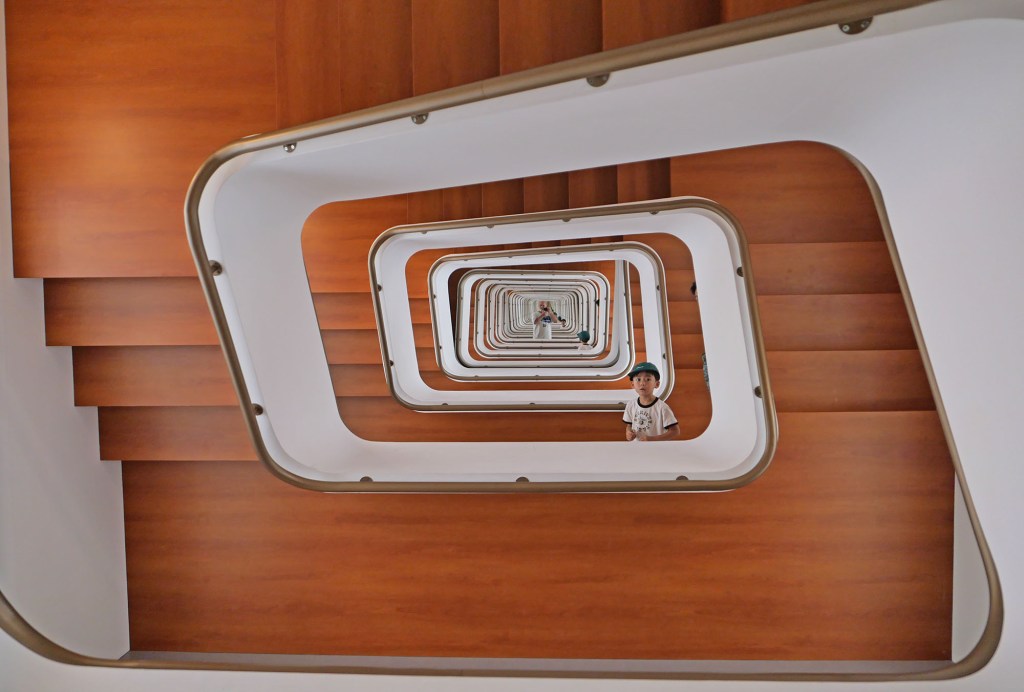
His art occasionally recalls René Magritte in the way it quietly unsettles certainty. At other times, it evokes M. C. Escher through impossible spaces and impossible perspectives. There are cinematic echoes as well, particularly of Alfred Hitchcock, who understood how an ordinary setting could become deeply unsettling. Yet Erlich imitates no one. Over the years, he has developed a visual language that is unmistakably his own.
Perhaps the most remarkable part of the experience begins after leaving the exhibition. The installations remain behind, but the uncertainty lingers. Shop windows, reflections, staircases and everyday architecture suddenly seem slightly different, as if the ordinary world had lost some of its certainty. Few artists manage to extend their work beyond the walls of a museum. That may well be the mark of the very best.
Grégory Herpe
Leandro Erlich
Grand Palais, Paris, France
June 2 – September 6, 2026


Leave a comment