The history of photography is a novel full of holes. Open any textbook: the names scroll past, Daguerre, Nadar, Cartier-Bresson, Ansel Adams, Robert Frank, Avedon, Newton, Klein. A gallery of solitary geniuses, singular minds, unique eyes.
Often men. Behind each name there were often other hands, other eyes, people who never got their signature on the cover. Assistants, wives, darkroom technicians, technicians in segregated studios, women whose discoveries were published under their partner’s name. Rewriting this history isn’t political correction, it’s archaeology. And what you find when you dig is often more interesting than what you thought you knew.
Solarization, or how a woman invented a technique a man made famous
In 1929, in Man Ray’s Paris studio, a young American photographer learning darkroom work accidentally switches on the light while a sensitized paper is still developing. The outlines of the shapes become edged in a luminous rim, the tones partially reverse. This woman is Lee Miller, she’s 22, and she has just discovered photographic solarization, or at least opened the door to what Man Ray will go on to name and systematize.
Man Ray will exploit this technique for years. It becomes one of his signatures, present in every retrospective under his name. Lee Miller, meanwhile, is long reduced to her role as muse and model, until historians dig through the correspondence and diaries of the period. Biographer Carolyn Burke, in Lee Miller: A Life (2005), is unambiguous: Miller discovered the technique first, and wrote about it herself in black and white. Man Ray never denied it outright, he just avoided confirming it.
The rest of her life alone disproves the idea of a mere assistant. Fashion photographer for British Vogue, then war correspondent, she photographs the liberation of Dachau and steps into Hitler’s bathtub in Munich the day the city falls. Lee Miller doesn’t need defending. She needs the record corrected.

Berenice Abbott: the woman who saved Atget’s work
Eugène Atget, the photographer who documented turn-of-the-century Paris before Haussmann-era demolition erased it, is a founding name in documentary photography. What gets said less often is that without Berenice Abbott, he probably wouldn’t exist as a major historical figure at all.
Abbott meets Atget shortly before his death in 1927 and immediately grasps the value of his work, something most of his contemporaries missed. When he dies, she buys his archive, thousands of glass negatives, with her own money, and spends decades preserving it, promoting it, submitting it to MoMA. Without this thankless, long-unpaid work, Atget’s body of work might have been lost in Parisian attics. Abbott herself is a major photographer, author of Changing New York (1939), a pioneer of scientific photography at MIT. But in the canon’s hierarchy, she remains first and foremost “the one who saved Atget.”

Dora Maar: beyond the muse
“The Weeping Woman,” Picasso’s painting for which Dora Maar modeled, long summed up nearly everything the public remembered of her. Born Henriette Theodora Marković in 1907, Maar is first and foremost a trained, radical photographer. Before her relationship with Picasso, she’s an active figure in the surrealist movement, author of highly sophisticated photomontages. Her Père Ubu (1936), a fetal armadillo shot from a low, menacing angle, ranks among the strongest surrealist images of the decade. She also photographs the poor neighborhoods of Paris and Barcelona, and documents the Spanish Civil War.
During her relationship with Picasso (1936-1943), she photographs the genesis of Guernica, dozens of shots of immeasurable value. But her own practice gradually fades: Picasso reportedly told her to give up photography and devote herself to painting. After the breakup, Maar falls into severe depression and withdraws. Only in the 1990s, thanks to research by Victoria Combalía, is her photographic work rediscovered. The Centre Pompidou gives her a retrospective in 2019. She died in 1997, after a long wait.

Vivian Maier and the uncomfortable question: who owns a body of work?
In 2007, John Maloof, a Chicago real estate agent, buys a lot of undeveloped negatives at auction for 380 dollars. Developing them, he discovers street images of stunning skill. Their author, Vivian Maier, has just died alone at 83, after a lifetime working as a nanny, photographing in secret and never seeking to show her work. Maloof develops, digitizes, exhibits, publishes, and turns her into a posthumous star.
A question few really ask remains: did Vivian Maier want her photos seen? She never showed them, never sought exhibition or recognition. That choice deserves as much respect as the work itself. Maloof’s discovery, however well intentioned, raises questions about who owns a body of work and about the right to anonymity. Maloof has since set up a foundation, bought up other lots, and become the primary, and commercial, custodian of her work.

“Autoportrait in New York”, by Vivian Maier (1953).
The women of the FSA: the great erasure
In the 1930s, the FSA (Farm Security Administration) sent photographers to document the Great Depression. Everyone knows Dorothea Lange and her “Migrant Mother” (1936), a photo now controversial after it emerged that Lange misrepresented the context of the shot. But who knows Marion Post Wolcott?
Wolcott worked for the FSA from 1938 to 1942. Her images of the South, rural poverty, Mississippi juke joints, Florida farmworkers, rival Lange’s best work. She photographed interiors, women, children, scenes a man’s presence would have made impossible. Her 1941 marriage effectively ended her career, under the weight of the era’s expectations. Her FSA work wasn’t truly recognized until the 1970s and 80s, thanks to historians combing the Library of Congress archives.

Hands in the tray: the myth of the print
There’s another kind of ghost in the history of photography: the darkroom technician, the one who sets the contrast, burns the highlights, dodges the shadows, and decides, in the silence of the darkroom, what the image will actually be.
Ansel Adams is famous for his Zone System, codified in a trilogy of manuals. His prints are works in their own right. But Adams had darkroom assistants, and some prints sold under his name were made or retouched by other hands, a common practice in major studios. The myth of the solitary photographer-printer deserves nuance. In the fashion studios of the 1960s and 70s, Avedon, Penn, Newton, the darkroom teams were large, highly skilled, and entirely anonymous. The retouchers who erased imperfections with brush and gouache signed nothing, yet they were co-authors of the image published in Vogue or Harper’s Bazaar.
Black photographers in white studios
In segregation-era America, from the 1920s through the 1960s, exceptionally talented Black photographers worked in near-total institutional invisibility. James Van Der Zee, official photographer of Harlem’s Black community for decades, weddings, portraits, funerals, is a living archive of the Harlem Renaissance. His work didn’t enter museums until the Harlem on My Mind exhibition at the Met in 1969. He was 73.
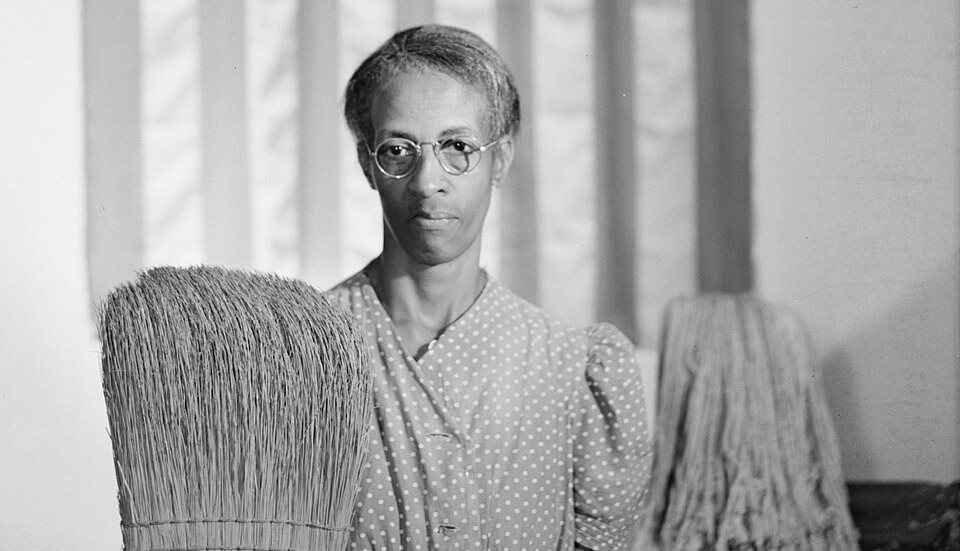
Gordon Parks, Life photographer, filmmaker, musician, is perhaps the most famous Black American photographer of the 20th century. His portrait of Ella Watson in front of an American flag, American Gothic (1942), ranks among the most powerful images in American photographic history. Yet he often remains a footnote in general histories dominated by FSA names, Magnum, William Klein’s New York.

What this changes, and what it should change
Restoring these names and this work isn’t an act of charity, it’s an exercise in historical precision. The history of photography as it was written, mostly by Western men in Western institutions, selected a canon that looked like its authors.
That canon has concrete consequences: it determines what gets taught, exhibited, sold at the highest prices. An Ansel Adams print regularly fetches several hundred thousand dollars at auction. A Marion Post Wolcott print, of comparable quality, sells for far less. Not because the images are worse, but because the narrative made them less visible.
The revisions underway, retrospectives, reissues, dissertations, exhibitions like the Dora Maar show at the Pompidou, are starting to correct this imbalance. But it’s slow. And for every photographer who gets rehabilitated, how many still sit in boxes, in uncatalogued archives, in auctions with no buyer? The history of photography isn’t finished. It’s still being written, and for the first time in a long while, it’s being written with names no one expected.
Grégory Herpe


Leave a comment