Some peoples have no embassies, no seat at the UN, no recognized passport. They have photographers.
Nagorno-Karabakh: I went there four times. It no longer exists.
I first set foot there before the 2020 war. I went back three times during it. I went everywhere: villages nobody visited, most of them in ruins, into the mountains, through minefields. I photographed the Armenian people who refused to leave, those who couldn’t, and those who were rebuilding the cities on the Azerbaijani side.
After the autumn 2020 war (forty-four days of fighting, thousands dead, a large part of the territory lost) something still remained. A reduced Republic of Artsakh (the other name for Nagorno-Karabakh), encircled, under a tightening blockade, but holding. People who kept farming, kept sending their children to school, in cities where entire neighbourhoods were nothing but charred shells.
Shusha (Armenians call it Shushi). Cultural capital, city of musicians and poets, the Ghazanchetsots church with its midnight-blue domes looking up at the sky. When I arrived, half the city had been blown apart. Buildings gutted, their insides open to the rain; flowered wallpaper from someone’s bedroom, upturned furniture, family photos still hanging on walls that no longer had a roof. In the streets, road signs and statues riddled with bullet holes. Few people, obviously. A handful of children, and I kept wondering how they still managed to go to school. Sometimes I couldn’t even tell who was Armenian and who was Azerbaijani; contact was complicated.
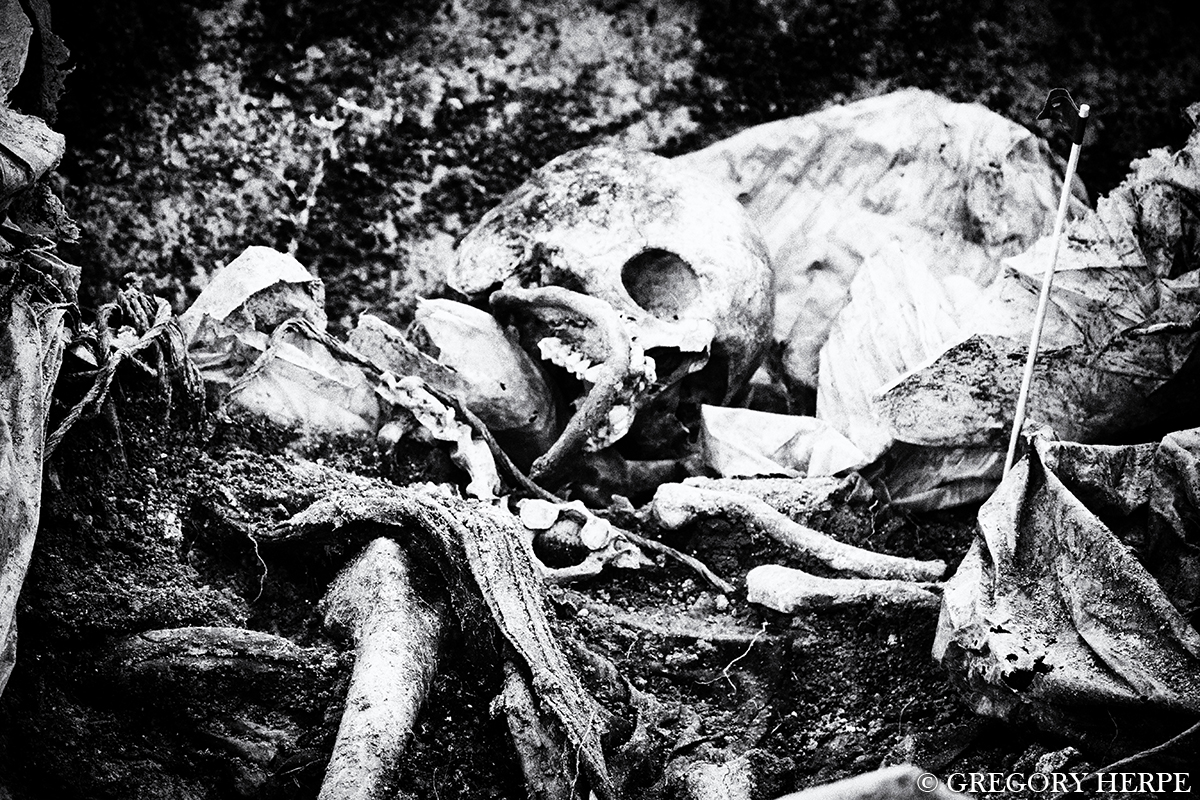
It was in Shusha, up in the mountains, that I learned Russia had invaded Ukraine. On my birthday. My son Arthur was with me, there to shoot video. It’s almost as if something extraordinary always happens in these countries that don’t exist. I also remember one evening when Alain Roumestand, a journalist friend, and I were eating while heavy machine-gun fire streaked across the night sky above our heads. And then there was the mass grave in the village of Edilli, which the Azerbaijanis were presenting as the work of the Armenians. Skulls, bones; a horrifying glimpse of what humanity is capable of. I’ll never know whether that grave was real or an Azerbaijani propaganda operation. That too is war: a game of bluff and deception.
These images, I exhibited them at the European Parliament in Brussels. Elected officials from twenty-seven countries walked past the exhausted faces, the burnt-out tanks, the bombed cities I had brought back from there. Did it change anything politically? Probably not. The fate of Nagorno-Karabakh was decided in offices where photographs don’t get access.
In September 2023, the offensive lasted seventy-two hours. More than 100,000 Armenians fled. The houses stayed. The cemeteries too, with their millennial khachkars, their carved stone crosses that no one will come to lay flowers on anymore.
My photographs stayed too. Documents of a vanished world. I thought I was doing photojournalism. I was doing archaeology without knowing it.
That’s what happens when you photograph ghost states: sometimes, between the shutter click and the print, the country has disappeared.

Somaliland: a country that appears on no map
In 1991, when Somalia collapsed into civil war, the north-western part of the country (the former British Somaliland) seceded and declared independence. Since then, the Republic of Somaliland has administered a territory of 137,000 km², with a capital city (Hargeisa), a currency (the Somaliland shilling), an army, an elected parliament, and regular multi-party elections. It is one of the most functional democracies in the Horn of Africa.
And yet: not a single country in the world has recognized it. Not the UN. Not the African Union. Officially, Somaliland does not exist.
Photographer Eric Lafforgue went there. Lafforgue (a French photographer, former advertising man turned documentary maker) is one of the very few Western photographers to have documented Somaliland extensively and repeatedly. His images show something that headlines about “Somalia” never do: daily life, a camel market, women in colourful dress, children playing in the dusty streets of Hargeisa, a stubborn normality in a country that isn’t allowed its own name.
That paradox is the very subject of these photographs. They don’t ask for pity; they ask for recognition. Not necessarily political recognition. Visual recognition, first. We exist. Look.

Kurdistan: photographing a nation without borders
Kurdistan is perhaps the most complex example of what it means to photograph a state that doesn’t exist; because Kurdistan is everywhere and nowhere. The Kurds (between 30 and 40 million people by most estimates) are spread across Turkey, Iraq, Syria and Iran. Four states that have each, in their own way, denied, suppressed or criminalized Kurdish cultural and political identity.
During the war against the Islamic State in Syria (2014–2019), the Kurdish militias (particularly the YPJ, the Women’s Protection Units, whose female fighters circulated around the world) were for a few years at the centre of global media attention. Photographers like Moises Saman (Magnum) and Jodi Bieber documented that moment. My son Arthur Herpe also went to Iraqi Kurdistan. He filmed and photographed life there; and above all, a welcoming people who suffer from being abandoned by the media but bear it without bitterness, with dignity.
I invite you to watch this short vlog about his encounter with a Yazidi leader in the mountains:
These images had real political power: they humanized a cause that most people couldn’t have placed on a map.
But photography of Kurdistan is also photography of grief. The grief of the Hakkari Kurds massacred in the 1920s. The Anfal genocide in Iraq (1986–1989), when Saddam Hussein’s regime used chemical weapons against Kurdish populations, killing between 50,000 and 100,000 people by most estimates. These events had photographers (not enough of them) and the archives exist in fragmentary, scattered form, mostly in private collections or association archives rather than in major museums.
To photograph Kurdistan today is to photograph a nation living in the space between words; in the silence of international treaties that don’t mention it, in the fragility of regional autonomies (Iraqi Kurdistan, the Autonomous Administration of North and East Syria) that can be revoked at any moment by a shift in regional alliances.
Western Sahara: photographers of the sand
Since 1975, Western Sahara has been one of the last non-self-governing territories listed by the UN; a colony without an officially recognized colonizer, under Moroccan administration, claimed by the Polisario Front and the Sahrawi Arab Democratic Republic (SADR), which around fifty states recognize.
The Sahrawis (the people of Western Sahara) have been living partly in refugee camps in Algeria, in Tindouf, for more than fifty years. These camps (Smara, Laayoune, Dakhla, Ausserd) are among the oldest refugee camps in the world. People were born there, grew up there, had children there, without ever having seen the land their parents talk about.
In these camps, photography plays a documentary and political role of particular intensity. Sahrawi photographers themselves have begun building visual archives of life in the camps; a life with its own aesthetic codes, its own rituals, its own austere beauty in a landscape of sand and tents. These archives are a counter-narrative: against the “refugee” images produced by international media (urgency, misery, waiting), they offer images of cultural resistance, celebration, transmission.
Photographers like Simon Brann Thorpe and Luc de Wurstemberger have documented Western Sahara and the camps from the outside, with a sensitivity that tries to avoid the trap of humanitarian voyeurism. But it is perhaps the photography produced from within (by Sahrawis trained in photography through cultural programmes funded by NGOs or sympathetic governments) that carries the strongest message.

Abkhazia and South Ossetia: the ghosts of the Caucasus
In 2008, the Russo-Georgian war froze two territories into a limbo that has lasted ever since. Abkhazia and South Ossetia declared independence from Georgia with Russia’s backing. They are recognized by Moscow, Nicaragua, Venezuela, Syria and a few others; and considered by the international community as occupied Georgian territories.
Abkhazia (a Black Sea coastal territory, former Soviet tourist destination) is perhaps the most melancholy example of these ghost states. The photographers who have worked there (Rob Hornstra, the photographer, and Arnold van Bruggen, the journalist, with their remarkable project The Sochi Project (2009–2013), a long-term documentary work on the South Caucasus ahead of the Sochi Olympics) found a territory inhabited by Soviet ruins, abandoned palm trees, empty swimming pools in hotels that no longer welcome anyone. A decadent beauty, slightly ghostly, slightly tragic.
The Sochi Project is one of the most successful examples of photography of states that don’t exist; it doesn’t seek political declaration but the texture of daily life. What it feels like to live somewhere the world doesn’t recognize. What it feels like to hold a nationality that no foreign airport will accept.

Transnistria: a country kept in the freezer
In 2023, I crossed the Moldovan border into Transnistria, again with my son Arthur. It isn’t really a border. It’s a checkpoint manned by soldiers still wearing Soviet uniforms, the red star emblem sewn onto the shoulder, in a country where the USSR has officially refused to end.
Transnistria is a 200-kilometre strip wedged between the Dniester river and Ukraine, technically inside Moldova. About 450,000 inhabitants. A currency (the Transnistrian ruble, and the coins are made of plastic!) that no bank in the world will ever accept. A government that has proclaimed itself a sovereign republic since 1990, recognized by nobody, not even Russia, which stations several thousand soldiers there. The most perfectly phantom state in Europe.
What surprises you arriving in Tiraspol is the absence of tension. You expected something heavy, paranoid. What you find is a normal city: busy markets, kids coming home from school. Behind all that, the Soviet backdrop, intact. Lenin statues on their pedestals, heroic worker murals on building facades, canteens decorated like something from 1950s USSR. Not a museum. Just there, as if nobody here had ever seen the point of changing anything.
To photograph, you have to be careful. Military buildings are off limits, checkpoints, anything touching the machinery of the state. I worked fast, without announcing myself, sitting somewhere and waiting for people to forget I was there. That’s what all slightly closed-off places eventually teach you.
I was looking for life inside the backdrop, not the backdrop itself. A dog in front of a Russian tank and a church. An old man on a bench wearing a cap that said “Fuck” (where on earth had he got it?). People in swimsuits on an improvised sandy beach by the river.
These images demand neither pity nor outrage. They just ask you to accept that people live there, with as much density and ordinariness as anywhere else; in a country the world has decided doesn’t exist, whether or not you agree with its politics.

Photography as the only act of existence
There’s a philosophical dimension to all of this that doesn’t get explored enough.
For a people without international recognition, photography is not merely a document; it is a claim to existence. Cogito ergo sum has been replaced by something like photographior ergo sum: I am photographed, therefore I exist. The image travels where the passport cannot. It enters museums, festivals, media, social networks; and it carries with it a reality that official maps refuse to record.
There is a long tradition of what Susan Sontag called the “politics of compassion” in documentary photography; the idea that an image of suffering creates a moral obligation in the viewer. For stateless peoples, it isn’t suffering that is primarily at stake, but the simple recognition of ordinary existence. A woman doing her shopping in Hargeisa. A child doing homework in a Sahrawi camp. A couple getting married in Abkhazia.
These images say: we are not a political problem. We are people.
What happens to archives when a state disappears
This experience raises an institutional question that nobody really anticipated: what do you do with the photographic archives of a state that ceases to exist?
When the Armenians fled, they took what they could carry in their arms. The institutional archives, the official photographs, the collections of local media; they stayed behind. In what condition, under whose control, with what future access: nobody knows.
It is a silent memorial catastrophe. Not as spectacular as the Islamic State’s destruction of the Palmyra mosaics, but just as definitive in its effects. The photographs that documented thirty years of ordinary life in the Republic of Artsakh are potentially lost to the very people they depicted.
This should be an urgent topic of discussion in the world’s major photographic institutions (Magnum, World Press Photo, museums, national libraries). There is still no international protocol for preserving the photographic archives of unrecognized or disappeared states. It is a gaping hole in the architecture of global memory.
Grégory Herpe

Leave a Reply