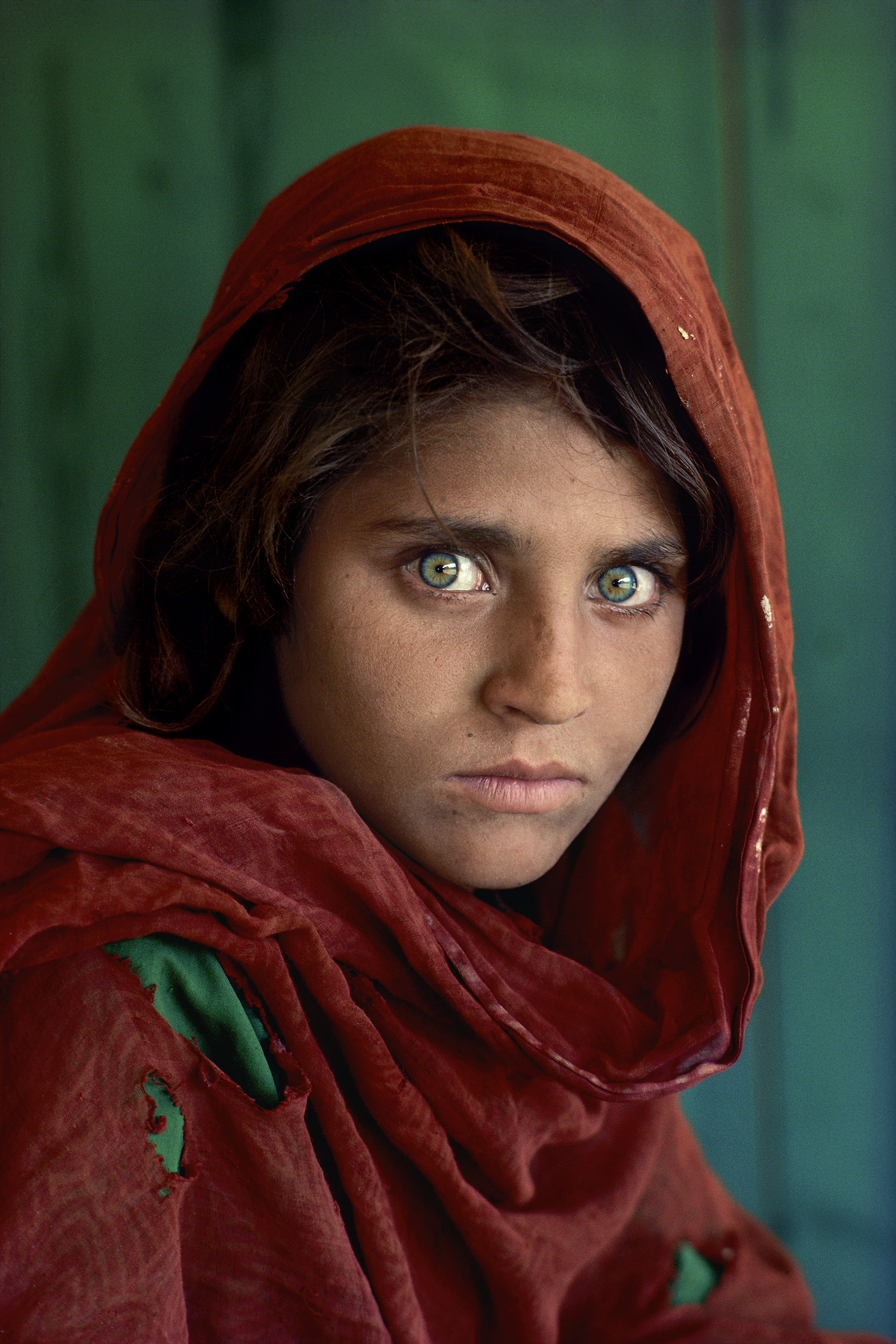
Steve McCurry has been one of the most accomplished photographers for the past forty years, telling visual stories of war and conflict, ancient and contemporary cultures, beautifully imperfect landscapes, and striking portraits.
His iconic photograph of the Afghan girl with piercing green eyes appeared on the June 1985 cover of National Geographic and became one of the most recognisable photographic portraits ever taken.
McCurry won numerous prestigious international awards, including the London Royal Photographic Society’s Centenary Medal for Lifetime Achievement, Robert Capa gold medal, National Press Photographers Award and four World Press Photo first prize awards. We talked about portrait photography, the Afghan girl, and the beauty of imperfection.
An exclusive interview for Midnight Express Magazine.
Hannah Starman: Portrait painters would argue that it takes time to capture another person’s face, and that photography is too instantaneous to do that. What would you respond to that?
Steve McCurry: A photograph can reveal a lot about an individual. I would take the exact opposite position on that. I would say that you can get a much more accurate view of someone’s personality with that instant photograph. If you are painting or drawing a subject, you can go in any direction you want. You can exaggerate something; you can interpret it in your own way. A photograph will reveal more accurately a person’s personality. It’s a surprising assertion. I don’t agree with it at all.
Hannah Starman: How do you establish a rapport with your subject, and how do your portraits then reflect this rapport?
Steve McCurry: It depends on how you respond to a situation and how long you spend with somebody. These things can happen fairly quickly. You don’t necessarily need to wait very long. Each encounter is different. Sometimes it takes just a few seconds. You see something, and you capture it. Other times it takes a bit longer for the person to reveal their personality. If you are observant and you can work quickly, if you have a keen sense of observation and a keen sense of timing, you can obtain interesting results.
Hannah Starman: You took thousands of portraits. Do you know most of the stories behind your pictures? Do you take notes about the people that you photograph?
Steve McCurry: It’s sometimes hard to remember details about photographs that I took thirty or forty years ago. If you take photos every day, it’s difficult to remember the circumstances of each encounter. I try to take notes, but sometimes I don’t speak the language and sometimes I just don’t have the time to do that.
Hannah Starman: Sharbat Gula, the Afghan girl with green eyes who made the cover of National Geographic, made you famous. You went back to look for her. Do you keep in touch with other subjects or is she an exception?
Steve McCurry: It’s not that often that you keep in touch. You are in these places and sometimes you go back and revisit places, but it’s rare. I used to give people that I photographed polaroid pictures, but now it’s more likely that I will email or text them an image, or send it by post. Sometimes it’s not possible to meet people again because it was a chance encounter.

Hannah Starman: You have taken hundreds of portraits of people, oftentimes in war-torn zones and world’s poorest countries. Do you ever feel that you need to give something back to the people that you have photographed?
Steve McCurry: Yes, I do want to do whatever I can for the people whom I photograph. Over the years I have tried to help as much as I can, but prefer to keep it confidential, for obvious reasons. I have stipulated for some of the corporate work that I have done, that we include donations for local charities and schools to ensure that we express our gratitude for the hospitality shown to us.
Hannah Starman: Tell us about your humanitarian work.
Steve McCurry: I have a foundation, ImagineAsia, that provides photography training to young Afghani girls. It gives them access to creative experience and the possibility to deploy it within their families and communities. The idea is that everybody should have an opportunity. I also give a lot of donations to charities, and we often put pictures up for charity auctions.

Hannah Starman: Have you ever been criticised for beautifying misery and war, like Sebastião Salgado with his series on famine?
Steve McCurry: I was just thinking about my career and my photographs and trying to imagine what could actually be considered beautifying a disaster or whatever. I think you just want to tell a story about a place or a situation, and do it in your own way. I don’t think Sebastião would intentionally go in to beautify famine. People will always want to criticise; I suppose it comes with the territory.
Hannah Starman: Take the image of the striking Afghan girl with those amazing green eyes that we discussed earlier. Some may reproach you that the beauty of the image distracts viewers from the fact that she was a poor refugee fleeing a war zone and that she had endured loss and misery.
Steve McCurry: I get that, and I understand that it’s a striking picture, but the reality is that I was in this tent and photographing very quickly. I shot what was in front of me. I think that people always want to criticise and belittle. There is a criticism along the lines of “what right does a white person from the West have to come over and photograph the people from Afghanistan when that story might have been better told, perhaps by an Afghan photographer who’s coming from that same culture.”
Hannah Starman: But that is why you are training the Afghan girls to be able to express themselves, right?
Steve McCurry: I sometimes hear: “He photographed her, but he has never compensated her for the picture.” I’m always amused by that because sometimes people, reporters, writers, etc. don’t want to take the time to actually research things. It’s easier and more fun to just throw these bombs at me. But if they had taken the time to research it, they would find out that we had helped Sharbat Gula for many years with all sorts of assistance and bought her a house.

Hannah Starman: And she wasn’t even aware that she was famous when you found her almost twenty years later. Is that correct?
Steve McCurry: Yes. This was a time when the Soviet Union and the Afghan government were systematically destroying tens of thousands of Afghan villages, and the Afghan people were desperate for help from wherever it came from- humanitarian help. They wanted to fight back. They were grateful for the attention of the people who wanted to actually do something to help them.
Hannah Starman: A few years ago, you had an exhibition in Geneva around the Japanese concept of Wabi-Sabi, the beauty of imperfection. What does the concept mean to you?
Steve McCurry: I’ve always been fascinated with the concept of Wabi-sabi, of beauty in its irregular nature. Finding beauty and being intrigued by sometimes a particular object that has a certain character of beauty or depth or some imperfection that tells a story has always captivated me. I find it endlessly fascinating how nature could create this sort of beauty, something that tells us an incredible story. I walk down the street and look at a wall or a piece of furniture or a crack in the sidewalk or some of these Zen Buddhist temples in Japan that have this wonderful design and natural shapes. This was what intrigued me about the project. I work with a colleague in Italy and I believe that she had visited the museum and they started the discussions. That’s how it unfolded.
Hannah Starman: What is the story of the tipped tower that you photographed in the Russian countryside?
Steve McCurry: We were riding around this village in Karelia one afternoon and I just saw on the side of the road. I was fascinated by this tower where they kept grain or something, but the top had this funny little tilt. It was fascinating. When you see the ravages of time, how, due to decay or some sort of structural problem, it took this funny shape. It’s this tall, elegant tower, but with a twist. I found it amusing.
Hannah Starman: You have travelled all over the world for decades. How did you cope with the slowdown during Covid?
Steve McCurry: I have been traveling for forty years. During Covid, I have spent a lot of time working on my archives. I had been neglecting them for twenty years, so that has been a great, serendipitous, turn of events. I was able to do two books during the pandemic: In Search of Elsewhere and Stories and Dreams: Portraits of Childhood. I also moved my studio and my apartment from New York to Philadelphia. Sometimes you need to sit, evaluate, and contemplate your work and your life. I also have a ten-year-old daughter; she was four years old when COVID began. Working at home has allowed me to spend more time with her and be kind of a more normal sort of at-home-dad as opposed to being away all the time.

Hannah Starman: You forgot to mention Belonging: Portraits from LGBTQ Thailand, which came out in 2021. How did that project come about?
Steve McCurry: Yes, you are right. I’ve been going to Thailand for years and years. My first trip to Thailand was in 1979. I was offered this project, and I thought that would be really interesting to explore something which I perhaps normally wouldn’t. I wanted to really delve into the subject, spend time on it, and learn about it. It was fascinating.
Hannah Starman: So what’s next?
Steve McCurry: I have a number of projects. I’m going to India and to Italy for workshops in October, and I’m working on another book.
Hannah Starman

Photographs © Steve McCurry. Published with the photographer’s permission. All rights reserved. The images remain the property and copyright of the photographer and may not be reproduced or used elsewhere without prior written permission.


Leave a Reply