Text & Photos Grégory Herpe
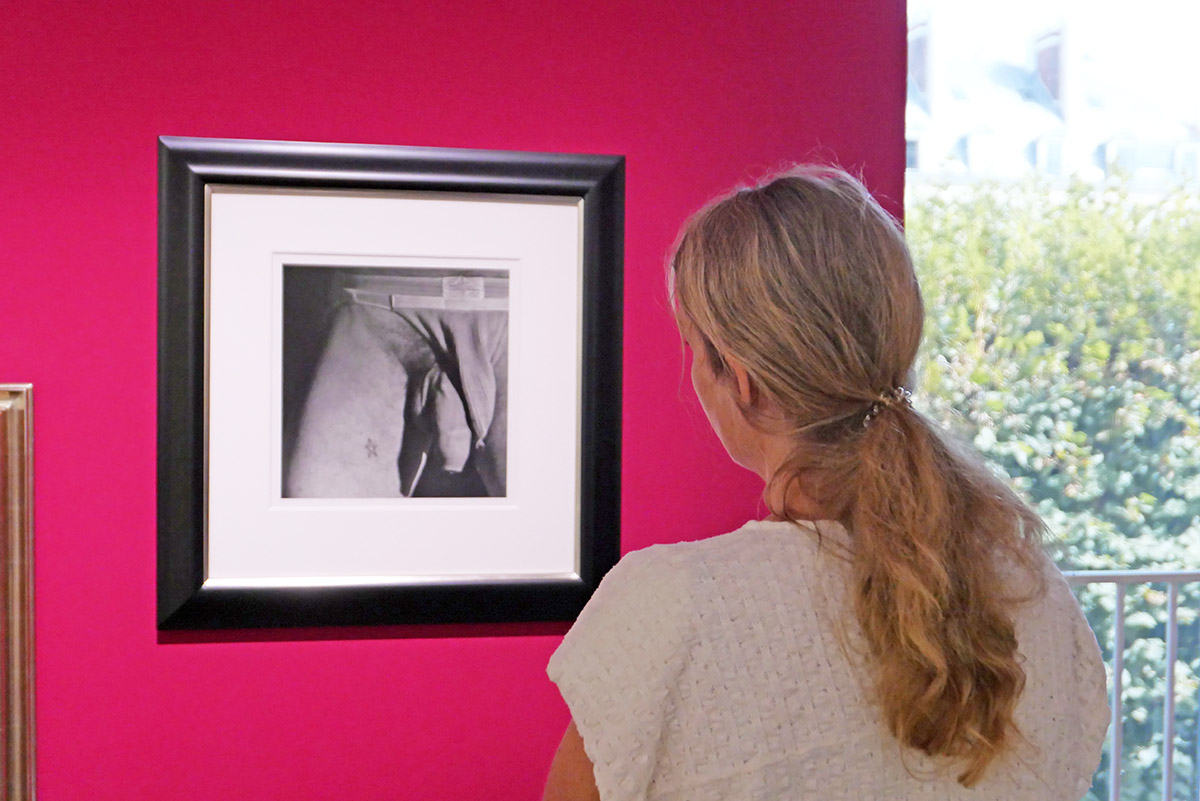
There is something almost dizzying about walking into an exhibition devoted to a private collection of more than 7,000 photographs.
Because a collection of this size inevitably ends up telling us more than simply what its owners like.
It tells the story of an era. Of obsessions. Of encounters. Of friendships. Of struggles. Of bodies. Of artists. And of deaths, too.
That is precisely what happens at the Jeu de Paume with Fragile Beauty, an exhibition devoted to the photography collection of Sir Elton John and David Furnish.
Elton John began collecting photography in 1991. More than thirty years later, the collection comprises over 7,000 prints and covers a substantial part of the history of modern and contemporary photography. For the Paris exhibition, more than 300 photographs by over 90 photographers are on display, spanning the 1950s to the present day.
And the names alone are enough to make you dizzy.
Robert Mapplethorpe, Nan Goldin, Diane Arbus, Irving Penn, Richard Avedon, Gary Winogrand, Herb Ritts, Peter Hujar, Robert Mapplethorpe, William Klein, Mary Ellen Mark, Ai Weiwei, Ryan McGinley, Robert Frank, Helmut Newton, Cindy Sherman, Sally Mann, Zanele Muholi, David LaChapelle and many others.

It would be easy to turn this exhibition into a catalogue of photography’s greatest names.
But that would miss the point.
What makes this collection so interesting is not simply the number of major photographers gathered under one roof. It is the way these photographs speak to one another, gradually building a much more intimate portrait of their collectors.
Elton John himself has spoken of a connection between photography and songwriting. In both cases, there is an element of chance. Something happens at the right moment and you have to know how to capture it.
That idea goes a long way towards explaining what we see at the Jeu de Paume.
This is not an academic history of photography.
It is a personal history.
The first photographs
Elton John’s early acquisitions included fashion photographs by Horst P. Horst, Irving Penn and Herb Ritts.
The choice is revealing.
All three represent a highly constructed and sophisticated form of fashion photography, often spectacular in its use of light, composition and black and white. But the exhibition then shows how photography gradually moved beyond the studio.
Urban settings replaced neutral backdrops. Photographers began working in the streets. Models became individuals. Fashion became intertwined with popular culture, then with streetwear and personal expression.
Guy Bourdin pushed fashion photography towards something more ambiguous and provocative. Frank Horvat took the camera into the city. Later, photographers such as Nontsikelelo Veleko became increasingly interested in the way clothing could become a language of identity.
Fashion, in this exhibition, is therefore already a question of identity.
And identity becomes one of the collection’s great recurring themes.
The stars behind the stars
Elton John is, of course, fascinated by celebrities.
But once again, the photographs selected tell a more complex story than a simple fascination with fame.
Elizabeth Taylor, Marlon Brando, Frank Sinatra, Doris Day, Aretha Franklin, Elvis Presley, Miles Davis, Chet Baker, Marilyn Monroe.
These are icons.
But they are also human beings photographed at very different moments in their lives.
A photograph of Marilyn Monroe preparing for a scene in Nevada has a very different impact from a carefully constructed glamour portrait. Chet Baker, photographed by Herman Leonard in New York in 1956, already appears as a strangely fragile figure behind the image of the great jazz musician.
The choice of these photographs reflects Elton John’s fascination with artists who devoted their lives to their work, sometimes at considerable personal cost. The Jeu de Paume specifically highlights the importance of Marilyn Monroe and Chet Baker within the collection.
A Terry O’Neill photograph of Frank Sinatra in Miami, surrounded by bodyguards with Mafia connections, reveals another side of celebrity: what lies behind the public persona.
The star becomes a photographic subject like any other.
They can be beautiful.
They can be vulnerable.
They can be alone.
Robert Mapplethorpe, Peter Hujar and the male body
This is probably one of the most important sections of the exhibition when it comes to understanding the personal dimension of the collection.
Photographs by Robert Mapplethorpe, Peter Hujar, Walter Pfeiffer, Herb Ritts and Pierre et Gilles explore the male body, desire and homosexual eroticism.

Some of these images were once regarded as scandalous or provocative.
Today, they are also traces of a cultural and political history.
Mapplethorpe and Hujar worked in New York during the 1970s, at a time when the gay rights movement was entering a new phase. Their photography was not simply about representing the male body. It also asserted an identity that had long been denied the same visibility as others.
Then came AIDS.
And everything changed.
Photography became a way of making visible a community devastated by an epidemic that wiped out a generation.
In the collection of Elton John and David Furnish, this history obviously carries a particular resonance. The Jeu de Paume underlines the importance of these photographers and these images within their collecting practice.
Photography was no longer simply a representation of desire.
It became a record of life, death and memory.
And then comes Nan Goldin
There is a moment when the exhibition changes completely.
You enter the world of Nan Goldin.
And suddenly, these are no longer simply a few photographs hanging together.
There are 149 prints from her Thanksgiving series, presented as a monumental installation.
One hundred and forty-nine photographs.
A journey through several decades of intimate life.
The series spans the years from 1973 to 1999 and brings together photographs of Goldin, her friends, lovers and chosen family. Some are joyful, others sexual, violent, tender or devastatingly painful.
It is probably the most moving body of work in the exhibition.
Because you quickly understand that Nan Goldin was not photographing an outside world.
She was photographing her own.
Her photography is one of absolute proximity.
The people she photographs are the people she lives with, loves, desires, parties with, argues with, travels with, sleeps beside and grows older with.
She does not position herself in front of them as an outside observer.
She is inside the world she is photographing.
That is what gives her images their strange power. They can look like stolen snapshots, yet they are actually fragments of relationships.
Goldin described The Ballad of Sexual Dependency, her best-known work, as a kind of diary that other people could read. The photographs emerge from relationships rather than observation.

That distinction is fundamental.
Nan Goldin is not photographing “marginal people”.
She is photographing her friends.
She is not photographing “the queer community”.
She is photographing her family.
She is not photographing “New York nightlife”.
She is photographing her own existence.
That proximity is what gives her images their extraordinary force.
It is also what makes Thanksgiving almost unbearably poignant when you know what happened to some of the people pictured.
An entire generation disappeared.
AIDS took the lives of many friends and loved ones.
Others were confronted with addiction, violence and loneliness.
Some photographs that might once have appeared simply celebratory become, years later, photographs of survivors.
Memories of people who are no longer there.
That is what gradually changes the way you look at the entire installation.
You are no longer simply looking at a photograph.
You are looking at memory.
Elton John acquired the Thanksgiving installation in 1999. Years later, it remains one of the most distinctive bodies of work in his collection. One photograph from the series, Klara and Edda Belly-Dancing, was even seized by British police during an exhibition in 2007 so that authorities could determine whether it constituted an offence. Elton John publicly defended the work, pointing out that it formed part of the complete installation of 149 photographs and had already been exhibited extensively.
That detail tells us something important.
These photographs were never designed to be comfortable.
They speak about sex, drugs, parties, love, violence, illness and death.
But above all, they speak about people.
And that is probably why they remain so powerful.
Photojournalism: when photography looks at the world
After Goldin’s intimacy and the photography of desire, the exhibition opens onto the outside world.
Photojournalism occupies an important place in the collection.
Elton John and David Furnish collect photographs connected to major political and social events, and they continue to acquire documentary and press photography today.
The exhibition returns in particular to the 1960s and the struggle for civil rights in the United States.
Pirkle Jones’s photograph of the Black Panthers at the Free Huey Rally in Sacramento in 1968 is a particularly powerful example.
Jones and Ruth-Marion Baruch photographed the Black Panther movement at a time when media representations of the organisation were often deeply polarised.
Photography offered another way of telling the story.
Not from a textbook.
From the street.
From faces.
From bodies.
The collection also includes photographs connected to the Vietnam War, political violence during the 1960s and the assassinations of leaders who shaped that period.

And it reaches all the way to September 11, 2001.
These photographs have something particular about them because many of them were seen at the very moment the events were unfolding.
They became historical images because they were first news images.
That is the power and ambiguity of photojournalism. A photograph may be taken for a newspaper in the morning and become, decades later, a historical document.
Elton John and David Furnish’s collection allows us to watch that transformation take place.
The Jeu de Paume also stresses that their interest in photojournalism continues today, with recent acquisitions placed alongside older works.
A collection that does not stop in the twentieth century
This is also what prevents Fragile Beauty from becoming a nostalgic journey through photographic history.
The collecting continues.
Contemporary photographers are very much present.
Harley Weir, Ryan McGinley, Zanele Muholi, Ai Weiwei and Tyler Mitchell appear alongside Penn, Avedon, Arbus, Mapplethorpe and Goldin.

The confrontation is revealing.
Because it allows us to see both what has changed and what remains.
Techniques change.
Formats change.
Representations of the body change.
Societies change.
But certain obsessions remain.
Desire.
Celebrity.
Loneliness.
Beauty.
Difference.
Violence.
Identity.
Freedom.
Fragility.

More than a collection of photographs
This is ultimately what makes Fragile Beauty so compelling.
You could enter the Jeu de Paume to see Robert Mapplethorpe, Nan Goldin, Diane Arbus, Irving Penn or Richard Avedon.
You leave having seen something else.
A personal history of photography.
A history in which fashion meets photojournalism, celebrity portraits meet photographs of marginalised communities, and the body becomes at different moments an object of desire, a political territory and evidence of vulnerability.
Above all, it is a history in which photography is never very far from life.
That may be why a photograph of Chet Baker can stand alongside an image of the Black Panthers, why Robert Mapplethorpe can enter into dialogue with Nan Goldin, why a photograph of Marilyn Monroe can hang only metres away from an image of war.
They are not the same photographs.
They do not belong to the same eras.
They do not tell the same stories.
But all of them speak, in one way or another, about what it means to be human.
And perhaps that is where the title of the exhibition finally makes sense.
Beauty is fragile.
A photograph can preserve a face after the person has disappeared.
A body after death.
A community after it has been erased.
A moment of freedom after the world has changed.
Perhaps that is why Elton John has been collecting photography for more than three decades.
Because a photograph does not merely show something.
Sometimes, it prevents something from disappearing.
Fragile Beauty: Photographs from the Collection of Sir Elton John and David Furnish is on view at the Jeu de Paume in Paris until September 24, 2026. More than 300 photographs by over 90 photographers are included in the exhibition. A special late opening takes place on Wednesday, September 23, until 9 pm.
Grégory Herpe


Leave a Reply